


In This Article
Recommended Books

Satan’s Lawfare: Job and the Government of God
In the first article of this series, we examined the darkness of Genesis 1:2, the rebellion that preceded Adam, and God's recovery of the earth beginning with the command, “Let there be light.” We also saw that before man received dominion, an organized heavenly government already existed.
But an important question remains. How could a created being such as Lucifer challenge the government of the God who created him, when he could never hope to defeat his Creator through superior power?
Scripture reveals that Satan's most consequential weapon was not strength. It was accusation, directed toward the righteousness of God and the standing of those who belonged to Him.
The clearest window into this conflict opens in an unexpected place: the book of Job.
God's Throne Is Founded Upon Righteousness
Before considering Satan's accusations, we must establish the character of the government against which he rebelled. God does not rule merely because He possesses greater power than every creature combined.
The psalmist declares:
“Righteousness and justice are the foundation of thy throne: Lovingkindness and truth go before thy face.”
— Psalm 89:14 (ASV)
God's authority is inseparable from His righteousness. His judgments are neither arbitrary nor dependent upon whatever advantage He can obtain through force.
This distinction is vital. Satan cannot impose a law above God, but he knows that God will not deny His own character to defeat a rebel.
An accusation, therefore, can become part of a genuine governmental conflict without ever making the accuser equal to the Judge. That is the setting into which Job takes us.
Job Opens the Heavenly Court
Most readers approach Job through the terrible losses he suffered on earth. Yet the book begins by revealing a scene Job himself never witnesses.
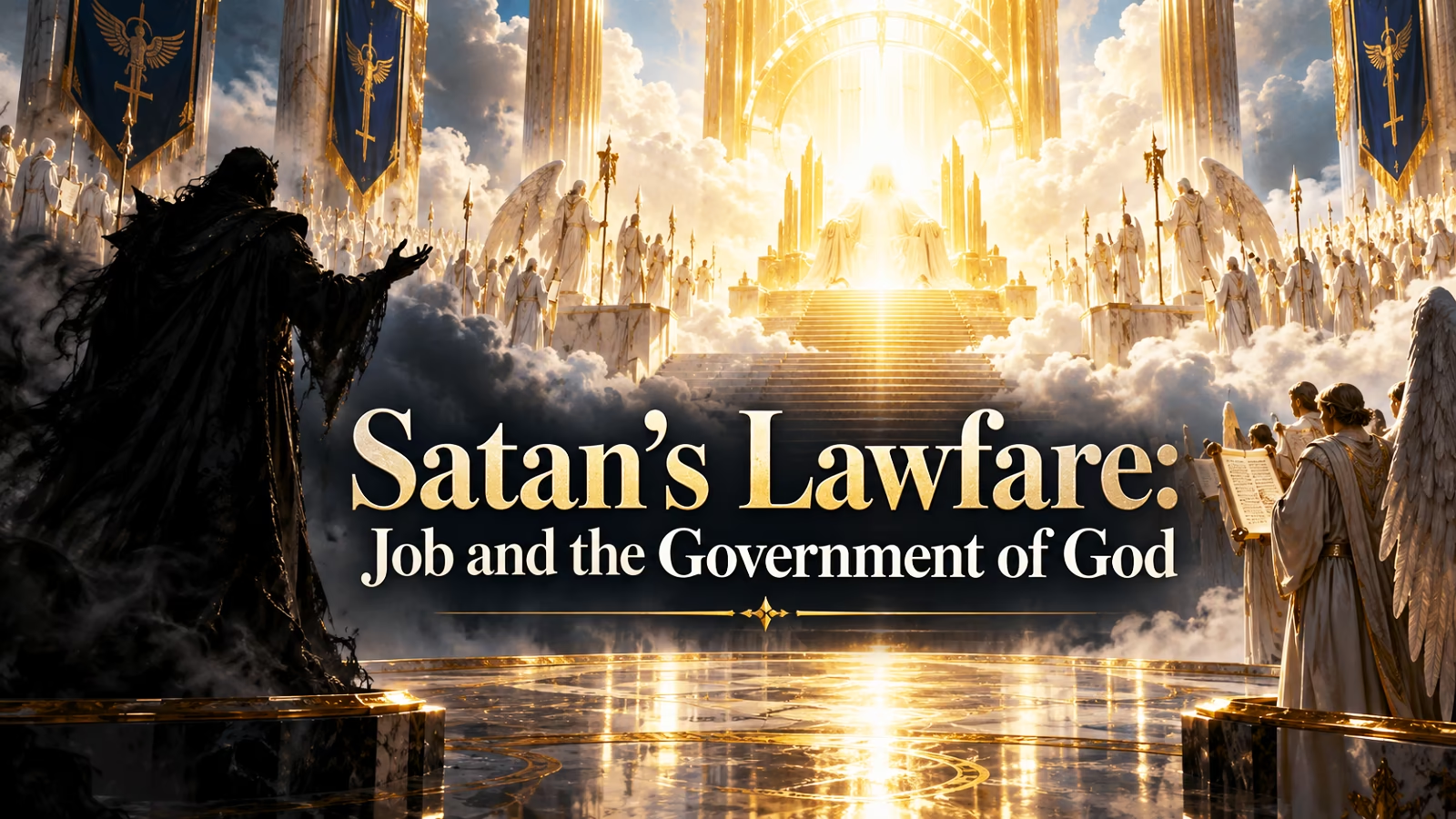
“Now it came to pass on the day when the sons of God came to present themselves before Jehovah, that Satan also came among them. And Jehovah said unto Satan, Whence comest thou? Then Satan answered Jehovah, and said, From going to and fro in the earth, and from walking up and down in it.”
— Job 1:6–7 (ASV)
The sons of God come to present themselves before Jehovah, and Satan appears among them. This is an established heavenly gathering, not a chance encounter between strangers.
God asks where Satan has come from, even though He does not need information about Satan's movements. In the setting of beings presenting themselves before His throne, the question concerns accountability.
Satan answers by describing his activity upon the earth. What follows reveals that his presence is connected to a challenge involving a man living there.
The Accusation Against Job
God directs attention to Job:
“And Jehovah said unto Satan, Hast thou considered my servant Job? for there is none like him in the earth, a perfect and an upright man, one that feareth God, and turneth away from evil.”
— Job 1:8 (ASV)
Satan does not dispute Job's wealth, influence, or circumstances. He challenges the integrity of Job's relationship with God.
“Then Satan answered Jehovah, and said, Doth Job fear God for nought? Hast not thou made a hedge about him, and about his house, and about all that he hath, on every side? thou hast blessed the work of his hands, and his substance is increased in the land. But put forth thy hand now, and touch all that he hath, and he will renounce thee to thy face.”
— Job 1:9–11 (ASV)
The accusation is calculated. Satan argues that Job's faithfulness is purchased by protection and prosperity; remove those benefits, and the man whom God has called upright will turn against Him.
This is more than an attack on Job's reputation. Satan challenges God's declaration concerning His servant and seeks to produce evidence that will overturn it.
He is not attempting to defeat God in combat. He is arguing a case before God's throne, with Job's conduct on earth becoming the contested evidence.
God Establishes the Boundaries
God allows Satan to test the accusation, but He defines the limits:
“And Jehovah said unto Satan, Behold, all that he hath is in thy power; only upon himself put not forth thy hand. So Satan went forth from the presence of Jehovah.”
— Job 1:12 (ASV)
Satan's activity is real, but it is not independent. He receives permission concerning Job's possessions and is expressly forbidden to touch Job himself.
When the heavenly gathering appears again in Job 2, the accusation returns. Job has endured devastating losses without renouncing God, so Satan presses the challenge further.
“And Jehovah said unto Satan, Behold, he is in thy hand; only spare his life.”
— Job 2:6 (ASV)
Even then, the boundary remains God's to establish. Satan can inflict suffering within what God permits, but he cannot set aside the judgment of the One before whom he stands.
The sequence makes the governing pattern visible:
- Accusation: Satan challenges God's testimony concerning Job.
- Permission: God allows the claim to be tested rather than accepting it as true.
- Boundaries: Satan operates only within limits established by God.
- Testimony: Events on earth reveal whether the accusation can stand.
The reader understands these proceedings, but Job does not. He experiences the earthly consequences without seeing the heavenly challenge behind them.
Satan's Weapon Was Lawfare, Not Superior Power
In modern language, Satan's method resembles lawfare: seeking advantage through accusation, disputed standing, and the application of governing principles rather than through superior force.
That term is an analogy, not a suggestion that God answers to some external court. There is no law above Jehovah, and Satan possesses no authority to make God unrighteous.
The important point is that God's righteousness cannot be separated from His government. Satan's strategy operated on the ground of that righteousness because he could never overpower the One who gives him existence.
God could have destroyed Satan by sheer power. Yet Scripture shows Him addressing accusation, exposing its claims, setting boundaries, and ultimately answering rebellion without compromising justice.
The conflict was never proof that God lacked strength. It revealed that God would deal with evil in a manner consistent with His own nature, not by becoming arbitrary in order to defeat arbitrariness.
Job makes this visible on a human scale. The accuser speaks, God rules, and the outcome on earth becomes testimony within a much larger governmental matter.
Satan Possessed Real but Limited Authority
The heavenly court in Job is not the only evidence that Satan exercises authority within the created realm. Jesus later calls him the prince of this world:
“Now is the judgment of this world: now shall the prince of this world be cast out.”
— John 12:31 (ASV)
Paul calls him the god of this world in 2 Corinthians 4:4, describing his work of blinding unbelieving minds. Neither description makes Satan equal to God; both acknowledge the reality of his influence and rule within a fallen order.
During the temptation of Christ, Satan makes his claim concerning the kingdoms:
“And the devil said unto him, To thee will I give all this authority, and the glory of them: for it hath been delivered unto me; and to whomsoever I will I give it.”
— Luke 4:6 (ASV)
Jesus rejects Satan's demand for worship without disputing the claim that authority over the kingdoms had been delivered to him. Taken with Christ's own description of Satan as prince of this world, the passage belongs to a consistent biblical picture.
Satan had genuine operational authority, but it was neither absolute nor beyond God's judgment. The created ruler had become a rebel, and his influence could not overturn the sovereignty of the Creator.
Zechariah Reveals the Same Accuser
Job is not an isolated scene. Centuries later, Zechariah describes another heavenly proceeding in which Satan opposes one who stands before God.
“And he showed me Joshua the high priest standing before the angel of Jehovah, and Satan standing at his right hand to be his adversary.”
— Zechariah 3:1 (ASV)
Joshua stands before the angel of Jehovah, while Satan stands in opposition. The setting again concerns standing before divine authority, rather than a struggle between evenly matched powers.
This time Joshua's condition supplies the accusation with an apparent basis:
“Now Joshua was clothed with filthy garments, and was standing before the angel. And he answered and spake unto those that stood before him, saying, Take the filthy garments from off him. And unto him he said, Behold, I have caused thine iniquity to pass from thee, and I will clothe thee with rich apparel.”
— Zechariah 3:3–4 (ASV)
God does not declare that uncleanness is harmless. He deals with Joshua's iniquity and provides clean clothing, so that the accusation does not determine Joshua's future.
Placed beside Job, this scene reveals a consistent pattern. Satan opposes and accuses; God's government answers according to righteousness and His own purpose.
The identity eventually given to Satan in Revelation confirms the importance of this activity.
Job's Own Words Reveal the Courtroom Theme
There is a remarkable connection between what Job wants and what the reader already knows. Job repeatedly desires to bring his case before God, unaware that the book has already opened in the heavenly court.
He declares:
“Oh that I knew where I might find him! That I might come even to his seat! I would set my cause in order before him, And fill my mouth with arguments.”
— Job 23:3–4 (ASV)
Job's language is judicial: a seat, a cause, and arguments to present. He seeks a hearing concerning events he cannot understand, while the reader knows that Satan's accusation preceded those events.
When Jehovah finally answers, however, He does not give Job a transcript of the heavenly proceedings. He takes Job back beyond his lifetime, to the ordering of creation itself.
“Where wast thou when I laid the foundations of the earth? Declare, if thou hast understanding. Who determined the measures thereof, if thou knowest? Or who stretched the line upon it? Whereupon were the foundations thereof fastened? Or who laid the corner-stone thereof, When the morning stars sang together, And all the sons of God shouted for joy?”
— Job 38:4–7 (ASV)
God speaks of the earth's foundations, established measures, and heavenly beings who rejoiced at creation. He continues with the boundaries of the sea and the ordering of things Job could never govern or fully understand.
The book begins with a heavenly assembly that Job cannot see and moves toward God's revelation of an order far older and greater than Job. His suffering is real, but the account exposes a governmental reality that cannot be understood by examining his earthly circumstances alone.
Job is therefore more than a manual on enduring hardship. It pulls back the curtain on God's government and the operation of Satan's accusation within it.
Revelation Shows the Accuser Losing His Place
Revelation identifies Satan by the very activity already visible in Job and Zechariah. Its account also shows what happens when his access to the heavenly realm ends.
“And there was war in heaven: Michael and his angels going forth to war with the dragon; and the dragon warred and his angels; and they prevailed not, neither was their place found any more in heaven. And the great dragon was cast down, the old serpent, he that is called the Devil and Satan, the deceiver of the whole world; he was cast down to the earth, and his angels were cast down with him.”
— Revelation 12:7–9 (ASV)
Then heaven declares the significance of the expulsion:
“And I heard a great voice in heaven, saying, Now is come the salvation, and the power, and the kingdom of our God, and the authority of his Christ: for the accuser of our brethren is cast down, who accuseth them before our God day and night. And they overcame him because of the blood of the Lamb, and because of the word of their testimony; and they loved not their life even unto death.”
— Revelation 12:10–11 (ASV)
The contrast with Job is striking. There Satan appears among the sons of God and speaks against a man on earth; here the accuser is cast down, and no place is found for him in heaven.
The blood of the Lamb is named in connection with the overcoming of the accuser. The judicial victory accomplished through Christ stands behind the open removal of Satan from his place of accusation.
God does ultimately employ power against His enemy. But the biblical account reveals that the enemy's accusations are answered through righteousness before his removal is openly enforced.
Why the Heavenly Court Matters
Satan's rebellion was never a contest between comparable powers. God's throne did not survive because He barely possessed enough strength to defend it.
The deeper conflict involved God's righteous government, the authority Satan exercised, and the accusations by which he sought to challenge those standing before God. Job gives us a rare view of that struggle while showing that Satan remains accountable to the very throne he opposes.
What begins in Job as an accusation is answered in a far greater way through Jesus Christ. Revelation shows the accuser losing his place, but the decisive question remains: How did God remove the very ground upon which Satan's accusations rested?
The answer brings us back to the new creature introduced in Genesis, made in God's image and entrusted with dominion. Through humanity, God Himself entered creation as the Son of Man and accomplished at the cross what no created power could accomplish.
In Part 3, “Why God Created Man: The Cross, the Kingdom, and New Jerusalem,” we will follow that answer from the Seed of the woman to Christ's judicial victory and the completion of God's eternal purpose.