

In This Article
Recommended Books

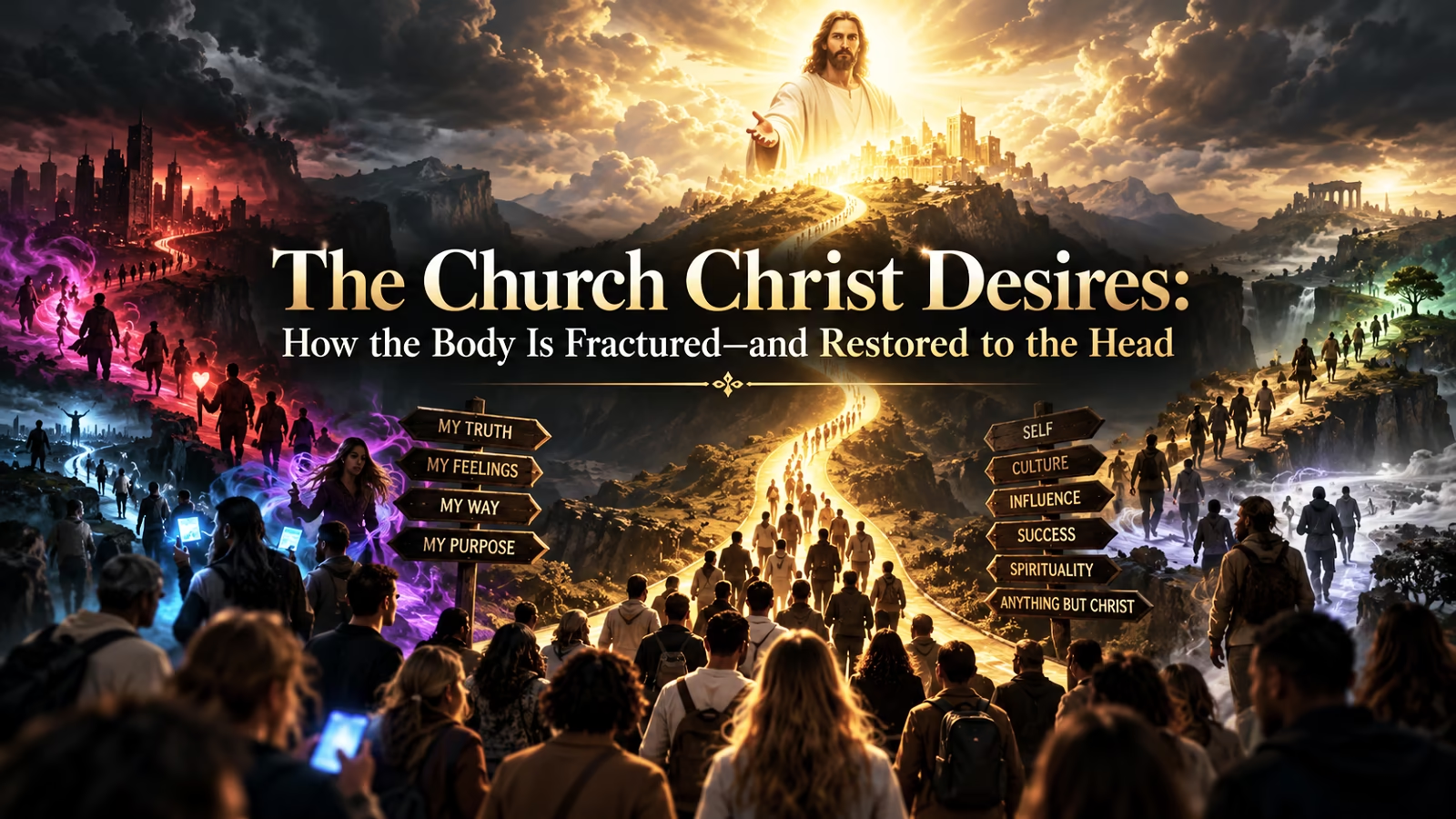
The Church Christ Desires: How the Body is Fractured and Restored to the Head
If the Church is one Body under one Head, a necessary question follows: What happens when its members cease living consciously under the government of the Head?
The Body itself does not cease to be one. God has established one Body and one Spirit, but the visible expression of that reality can become terribly fractured when believers begin functioning from another governing source.
The New Testament does not leave this problem unexplained. Revelation 2–3 shows Christ examining His churches, while Romans 7–8 and Paul’s letters reveal the conflict between the flesh and the Spirit and show the only true pathway back to healthy expression: restoration to the living Head.
Christ Examines His Churches
The seven churches of Revelation do not represent seven consecutive historical ages. Taken together, they present a complete spiritual diagnosis of conditions that can exist among churches throughout the Church age.
Christ does not merely expose failure. Within His corrections, He also identifies what He values.
At Ephesus, He recognizes labor, endurance, discernment, and refusal to tolerate false apostles, yet exposes the abandonment of first love. Smyrna displays faithfulness under suffering and spiritual riches despite outward poverty.
At Pergamos, despite serious corruption requiring correction, Christ acknowledges those who hold fast His name and refuse to deny the faith. At Thyatira, He recognizes love, faith, service, patience, and works that have increased.
In Sardis, even amid widespread spiritual deadness, Christ identifies a few who have not defiled their garments. Philadelphia has little strength, yet keeps Christ’s Word and refuses to deny His name, and before them He places an open door.
Then comes Laodicea, outwardly confident and self-sufficient while inwardly poor, blind, and naked. Christ exposes their condition and tells them exactly what they need from Him.
Then His language widens.
“As many as I love, I reprove and chasten: be zealous therefore, and repent.”
— Revelation 3:19, ASV
The language is no longer merely a description of one local condition. Christ speaks of as many as He loves.
Then the appeal becomes individual:
“Behold, I stand at the door and knock: if any man hear my voice and open the door, I will come in to him, and will sup with him, and he with me.”
— Revelation 3:20, ASV
Then the promise reaches the overcomer:
“He that overcometh, I will give to him to sit down with me in my throne, as I also overcame, and sat down with my Father in his throne.”
— Revelation 3:21, ASV
Finally, Christ closes with words addressed beyond any one local church:
“He that hath an ear, let him hear what the Spirit saith to the churches.”
— Revelation 3:22, ASV
Laodicea remains included, but the appeal now embraces all whom Christ loves, every individual who hears, every overcomer, and all the churches.
To hear what the Spirit says is to hear what the living Head is saying to His Body.
A Healthy Church Can Be Corrected
One of the clearest signs of spiritual health is not perfection but responsiveness to Christ.
Throughout Revelation 2–3, Christ repeatedly calls His people to hear, repent, remember, hold fast, overcome, and return. The churches differ greatly in condition, but the governing issue remains whether they will hear what the Head is saying.
A living Church does not defend something merely because it is traditional, familiar, successful, or deeply valued. When Christ exposes something contrary to Himself, the proper response of the Body is to listen.
This requires genuine teachability. The Church must be willing to test what it believes and practices, hold fast what is good, and abandon what the Head exposes as contrary to Himself.
Christ does not correct His Body in order to destroy it.
He corrects because it belongs to Him.
Led by the Living Head
Organization cannot produce the Church revealed in the New Testament. Neither can correct doctrine, gifted leadership, emotional worship, or religious activity substitute for members actually living under the government of Christ.
Paul writes:
“For as many as are led by the Spirit of God, these are sons of God.”
— Romans 8:14, ASV
This is not mysterious machinery operating inside the believer. Christ is the Head, and the Spirit is Christ present and operative in His Body.
Paul gives the practical pathway:
“For they that are after the flesh mind the things of the flesh; but they that are after the Spirit the things of the Spirit.”
— Romans 8:5, ASV
The believer sets the mind upon the Spirit, and therefore upon the living Head. The Head leads, while the member consciously listens, responds, chooses, obeys, serves, speaks, loves, gives, suffers, and functions according to the supply he receives.
The Spirit does not erase the member’s humanity or personal responsibility. He brings the member into living fellowship with Christ so that the life and government of the Head can find expression through the member.
That distinction becomes especially important when we ask how sincere Christians can become divided while each remains convinced that he is right.
When Inward Certainty Replaces the Head
A person may reason carefully, examine the available evidence, become convinced of a conclusion, and feel completely settled about it. None of those things, by themselves, proves that the Head is leading.
Confidence can accompany truth.
Confidence can also accompany the flesh.
Romans 7 reveals sin operating in the members and warring against the mind. The problem therefore cannot be solved merely by telling a person to think harder, reason more carefully, become more sincere, or strengthen his determination.
Romans 8 brings the mind under another government—the Spirit.
The flesh can influence reasoning, desire, emotion, conviction, and final judgment while still allowing a person to feel completely sincere. A conclusion can feel coherent, responsible, carefully considered, and emotionally settled while its governing source remains the self rather than Christ.
This helps explain something otherwise difficult to understand: sincere believers can reach deeply conflicting conclusions while each remains convinced that he is following what is right.
The test of spiritual leading is therefore not intensity of feeling, inward certainty, excitement, confidence, or emotional peace.
The question is whether the member is consciously living under the government of the Head.
When Spiritual Experience Becomes the Authority
Feelings are real. Emotions are real, and powerful inward experiences can accompany genuine encounters with God.
The danger begins when those experiences become governing authorities.
A person can feel inspired, peaceful, excited, deeply moved, or spiritually charged without necessarily being led by the Spirit. The Body is not governed by the intensity of the member’s experience but by its Head.
When inward experience becomes the final authority, the member begins functioning from himself. His reasoning, emotions, desires, convictions, preferences, or impressions effectively occupy the place that belongs to Christ.
The language of spirituality may remain while the practical government of the Head has been displaced.
The same thing can happen collectively. A church may have moving music, emotional intensity, excitement, gifted personalities, impressive activity, and powerful experiences, yet none of these things proves that the gathering is functioning under Christ.
True spirituality is not intensified inward feeling.
It is conscious life under the government of Christ the Head.
The Flesh Fractures the Visible Body
Paul directly connects division among believers with the flesh.
Speaking to the Corinthians, he writes:
“for ye are yet carnal: for whereas there is among you jealousy and strife, are ye not carnal, and do ye not walk after the manner of men?”
— 1 Corinthians 3:3, ASV
Galatians likewise places enmities, strife, jealousies, factions, divisions, and envy among the works of the flesh. These conditions do not arise because Christ’s Body actually possesses multiple Heads; they arise when members cease functioning under the one Head.
The flesh can express itself through obvious selfishness, but it can also appear through pride, ambition, jealousy, personality-following, desire for preeminence, religious enthusiasm, personal conviction, and confidence in one’s own judgment.
That is why division cannot always be solved simply by determining which person feels most strongly, argues most persuasively, or appears most sincere.
The deeper issue is government.
Romans 7 exposes the inability of the self-governed person to overcome the law operating in his members by greater self-effort. Romans 8 answers that failure by bringing the mind under the Spirit—the living presence and government of the Head.
The deepest answer to division is therefore not merely better conflict resolution.
It is restoration to the Head.
One Head produces one Body in living expression. Many independently governed members produce fracture.
The Body Is Already One
Before the cross, Christ prayed for those who would believe in Him through the testimony of His apostles:
“that they may all be one; even as thou, Father, art in me, and I in thee, that they also may be in us: that the world may believe that thou didst send me.”
— John 17:21, ASV
He continues:
“And the glory which thou hast given me I have given unto them; that they may be one, even as we are one;”
— John 17:22, ASV
Christ is not asking human beings to manufacture spiritual unity through organization.
The Body is already one.
The practical question is whether that existing oneness becomes visible through members who live in the Head. The Church expresses what God has already established as believers remain joined to Christ, receive from Him, set their minds upon the Spirit, love through His life, and submit to His government.
True unity therefore cannot be produced merely by placing divided believers under the same institutional structure. Neither can it be maintained by suppressing truth for the sake of outward agreement.
The unity originates in Christ.
Its visible expression comes as the members live under Him.
Returning to the Head
The New Testament picture is remarkably consistent.
The Church is one Body under one Head, living in one Spirit. Every member has value and function, while Christ alone has the preeminence.
When that relationship is healthy, truth is spoken in love. The saints care for one another, share one another’s sufferings and honor, forgive, restore, teach, encourage, warn, pray, give, serve, bear burdens, and build one another up.
They keep Christ’s Word and refuse to deny His name. They remain faithful under suffering, pure amid corruption, awake amid spiritual deadness, humble in weakness, responsive to correction, and dependent upon the life of the Head.
Their ministries equip rather than replace the saints, and their gifts build the Body rather than elevate individuals.
- Their love is not manufactured.
- Their holiness is not imitation.
- Their unity is not organizational.
- Their spirituality is not emotional self-government.
Their life comes from Christ.
The divisions visible throughout Christianity do not change what Christ’s Body is. They reveal how far its visible expression can fall short when members cease functioning under the government of their Head.
The answer is therefore not another movement, stronger institution, better organization, greater activity, more compelling personalities, or more intense spiritual experiences.
The answer is a return to the Head.
As the members hold fast to Christ, set their minds upon the Spirit, receive from the Head, submit to His government, and serve according to the measure He supplies, the Body begins again to appear as Paul described it:
“from whom all the body fitly framed and knit together through that which every joint supplieth, according to the working in due measure of each several part, maketh the increase of the body unto the building up of itself in love.”
— Ephesians 4:16, ASV
That is the Church restored to healthy expression:
many members, one Body, one Spirit, one life, one love, and one glorious Head—Jesus Christ.
Read Part 1: The Church Christ Desires: One Body Under One Head