

In This Article
Recommended Books
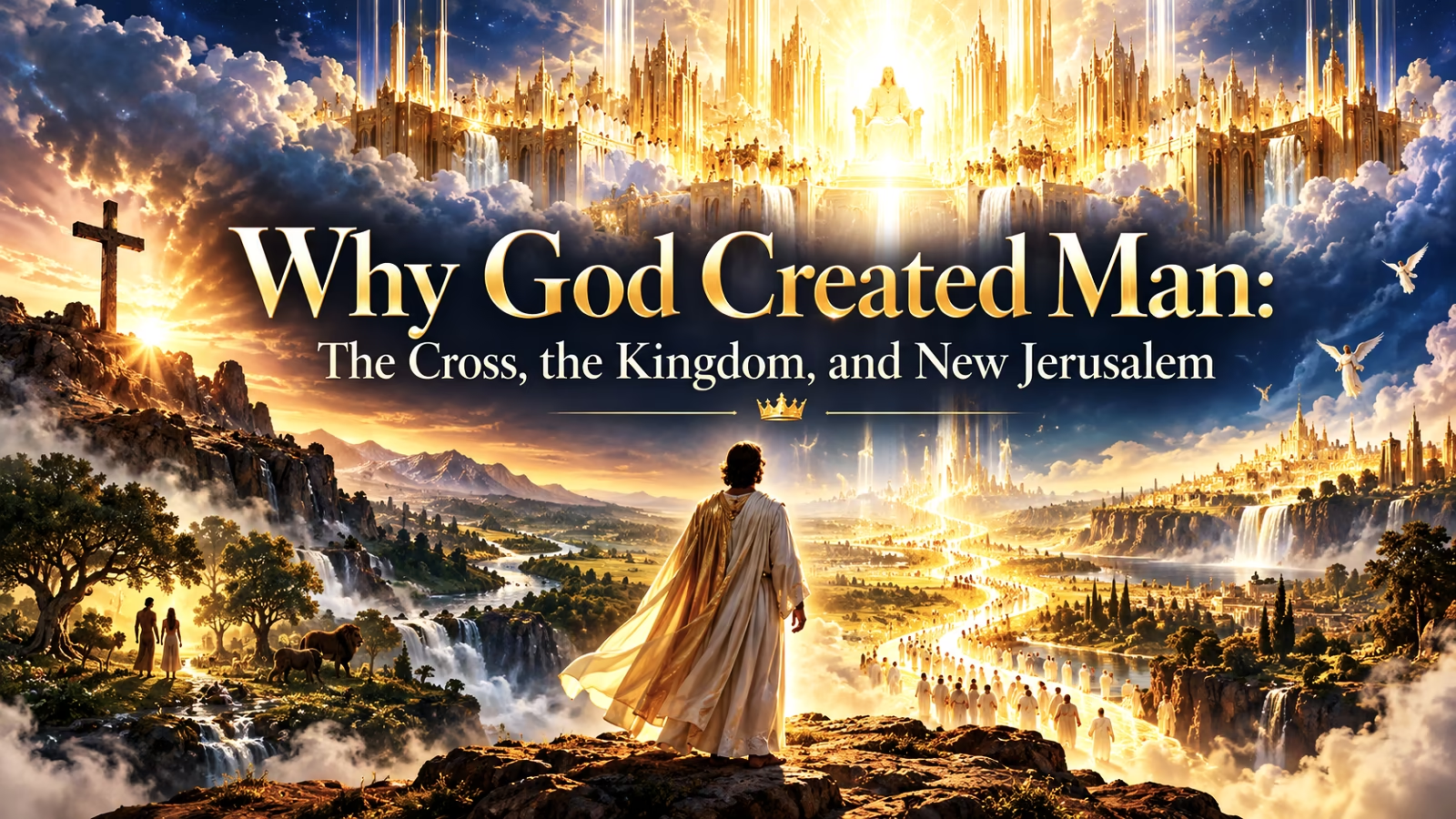
Why God Created Man: The Cross, the Kingdom, and New Jerusalem
Why did God create man?
The familiar answers are that God wanted fellowship, that man was created to worship Him, and that the redeemed would ultimately become the Bride of Christ. These are genuine dimensions of God's purpose, but they do not explain everything Scripture reveals about man's creation.
In the first two articles of this series, we examined the rebellion that preceded Adam, the judgment and recovery of creation, and the heavenly governmental conflict revealed in Job. We discovered that Satan could never defeat God through superior power, but operated through accusation against the righteousness of God's government.
Now we come to the extraordinary answer God prepared.
Following the recovery of the earth, God introduced a creature unlike anything previously described in Genesis. He created man in His own image, entrusted him with dominion, and established the humanity through which God Himself would eventually enter creation as Jesus Christ.
The creation of man was central to God's answer to Satan's rebellion and to the fulfillment of His eternal purpose.
To understand why, we must follow the biblical account from Adam to the cross, and from the cross to the throne of God in New Jerusalem.
Man Was Created in God's Image for Dominion
During the six days of Genesis, the living creatures are brought forth according to their kinds. Vegetation, sea creatures, birds, and land animals appear within the established order of creation.
But when God reaches man, the language changes.
"And God said, Let us make man in our image, after our likeness: and let them have dominion over the fish of the sea, and over the birds of the heavens, and over the cattle, and over all the earth, and over every creeping thing that creepeth upon the earth."
— Genesis 1:26 (ASV)
God does not command the earth to bring forth man after an existing earthly kind. He declares His intention to make man according to His own image and likeness.
Notice that image and dominion appear together. Man is created to represent God within creation and is immediately entrusted with authority over the earthly realm.
Genesis confirms:
"And God created man in his own image, in the image of God created he him; male and female created he them."
— Genesis 1:27 (ASV)
The distinction is fundamental. The other living creatures belong to their respective created kinds, while man's identity is expressly connected to God's image.
Man was not given independent sovereignty. His authority was delegated by the Creator whose image he bore.
Why Image and Authority Belong Together
The preceding articles established that heavenly government existed before Adam. Lucifer's rebellion challenged that government, and its consequences extended into the created realm.
Now, within the recovered earth, God establishes a new representative of His authority.
The significance reaches beyond Adam's original responsibilities in Eden. The humanity created in God's image would ultimately become the humanity through which the eternal Son entered creation.
Hebrews provides an extraordinary confirmation concerning man's place in God's purpose:
"For not unto angels did he subject the world to come, whereof we speak."
— Hebrews 2:5 (ASV)
Although angels possessed heavenly responsibilities before man existed, Scripture does not place the coming world under their government.
The passage continues by directing attention to man and ultimately to Jesus, who was crowned with glory and honor through suffering.
God's purpose for humanity, therefore, extends far beyond man's original dominion over the animals. It reaches forward to Christ and the government of the coming kingdom.
Man's Fall Did Not Cancel God's Purpose
Satan's entrance into Eden introduced rebellion into humanity. Adam disobeyed God, and sin and death entered the human race.
Paul explains:
"Therefore, as through one man sin entered into the world, and death through sin; and so death passed unto all men, for that all sinned:—"
— Romans 5:12 (ASV)
The creature made to express God's image and exercise His government had now come under the consequences of sin. Through Adam's disobedience, humanity became subject to death.
But God's purpose did not begin with Adam's fall, and it was not defeated by it.
Immediately after the transgression, God addressed the serpent with a declaration that would govern the unfolding conflict:
"and I will put enmity between thee and the woman, and between thy seed and her seed: he shall bruise thy head, and thou shalt bruise his heel."
— Genesis 3:15 (ASV)
The promise is remarkable because the serpent's defeat will come through the Seed of the woman.
God does not announce that an angel will defeat the serpent. Neither does He declare that He will simply destroy the rebel by an immediate display of overwhelming power.
The promised victory is connected to human offspring.
The enemy who deceived humanity will be defeated through humanity, but not through another fallen descendant of Adam acting in his own strength.
That distinction leads directly to the incarnation.
The Seed of the Woman and the Last Adam
Paul identifies Adam as the man through whom sin entered the world. He also establishes the contrast between Adam's disobedience and Christ's obedience.
"For as through the one man's disobedience the many were made sinners, even so through the obedience of the one shall the many be made righteous."
— Romans 5:19 (ASV)
The comparison is not merely between two influential religious figures. Paul presents two men whose actions have consequences extending to those identified with them.
Through Adam came sin and death. Through Jesus Christ come righteousness and life.
Why the Virgin Birth Matters
The promise of the woman's Seed becomes clearer when we examine the birth of Jesus.
When Gabriel announces that Mary will bear a son, she asks how this can happen without having known a man.
"And Mary said unto the angel, How shall this be, seeing I know not a man? And the angel answered and said unto her, The Holy Spirit shall come upon thee, and the power of the Most High shall overshadow thee: wherefore also the holy thing which is begotten shall be called the Son of God."
— Luke 1:34–35 (ASV)
Jesus entered genuine humanity through Mary, but His conception did not originate through an Adamic father. He was conceived through the Holy Spirit.
This distinction matters because Scripture traces humanity's fallen condition through Adam's headship. Christ enters the human race through the woman without being generated through the ordinary paternal line of fallen Adam.
His humanity was real, but He did not share Adam's sinful condition.
Hebrews declares that Jesus was tempted in every respect as we are, yet without sin (Hebrews 4:15).
Paul then identifies Him as the last Adam:
"So also it is written, The first man Adam became a living soul. The last Adam became a life-giving spirit."
— 1 Corinthians 15:45 (ASV)
The first Adam brought humanity under death. The last Adam came to overcome death and impart life.
This is not an incidental resemblance between Adam and Christ. It is the fulfillment of a divine purpose that began when God created man in His own image.
God Entered Creation Through Humanity
The eternal Son did not begin to exist when Jesus was born. John establishes that the Word was with God in the beginning and that all things were created through Him.
Then John makes an astonishing declaration:
"And the Word became flesh, and dwelt among us (and we beheld his glory, glory as of the only begotten from the Father), full of grace and truth."
— John 1:14 (ASV)
The One through whom creation came into existence entered that creation as a man.
This reveals an essential reason humanity occupies such a distinctive place in God's purpose. Through man, God could enter the created realm personally, not as a fallen creature, but as the sinless Son of Man.
Hebrews explicitly connects Christ's participation in humanity with the defeat of the devil:
"Since then the children are sharers in flesh and blood, he also himself in like manner partook of the same; that through death he might bring to nought him that had the power of death, that is, the devil; and might deliver all them who through fear of death were all their lifetime subject to bondage."
— Hebrews 2:14–15 (ASV)
Notice the sequence. Christ partook of flesh and blood so that through death He could bring the devil's power to nothing.
Satan could never defeat God through strength, but the eternal Son would defeat Satan by entering humanity and passing through death.
The incarnation was therefore not merely a means of appearing among men. It was essential to the way God accomplished redemption and answered the rebellion within creation.
Without humanity there is no incarnation as the Son of Man. Without the incarnation, there is no death of the sinless Man who defeats the devil through His death.
The Cross Was a Judicial Victory
In Part 2, we examined how Satan operated through accusation before God's heavenly government. Job and Zechariah revealed the accuser's activity, while Revelation identified him as the one who accused God's people before His throne.
The cross answers that accusation at its foundation.
Jesus Himself connects His approaching death with judgment upon Satan's authority:
"Now is the judgment of this world: now shall the prince of this world be cast out."
— John 12:31 (ASV)
Jesus does not describe the cross merely as an act of suffering. He calls it judgment.
Paul explains how God dealt with the legal ground of condemnation:
"having blotted out the bond written in ordinances that was against us, which was contrary to us: and he hath taken it out that way, nailing it to the cross; having despoiled the principalities and the powers, he made a show of them openly, triumphing over them in it."
— Colossians 2:14–15 (ASV)
The order is significant. The bond against us is removed, and the principalities and powers are openly defeated.
Satan's accusation depended upon the reality of sin and condemnation. God did not overcome that accusation by pretending sin was harmless or by simply refusing to acknowledge His own righteous standard.
He dealt with sin through the death of Jesus Christ.
God Remained Righteous While Justifying Man
Paul makes the judicial significance unmistakable:
"for the showing, I say, of his righteousness at this present season: that he might himself be just, and the justifier of him that hath faith in Jesus."
— Romans 3:26 (ASV)
God remains just while justifying the believer.
This is the decisive answer to Satan's lawfare. The enemy's strategy relied upon accusation and upon God's refusal to violate His own righteousness.
At the cross, God demonstrated that His justice and His mercy were not in conflict. Through Christ, He could righteously forgive sin, justify the believer, and disarm the accusing powers.
Satan's accusation was answered through righteousness, not through a suspension of righteousness.
The cross accomplished what overwhelming force alone could never demonstrate: the complete defeat of the accuser's grounds without any compromise of God's character.
From Judicial Victory to the Enforcement of Judgment
The victory of the cross explains the events later revealed in Revelation.
Job showed Satan appearing before God and bringing accusations against a man on earth. Revelation 12 shows the accuser losing his place in heaven.
Following the account of Michael and his angels defeating the dragon, heaven announces:
"Now is come the salvation, and the power, and the kingdom of our God, and the authority of his Christ: for the accuser of our brethren is cast down, who accuseth them before our God day and night."
— Revelation 12:10 (ASV)
The following verse identifies the basis upon which the brethren overcame him:
"And they overcame him because of the blood of the Lamb, and because of the word of their testimony; and they loved not their life even unto death."
— Revelation 12:11 (ASV)
The distinction is important. The blood of the Lamb answers the accusation, while the heavenly conflict brings the removal of the accuser from his place.
The judicial victory precedes the open enforcement of judgment.
God was never unable to destroy Satan. Rather, the biblical record reveals Him resolving the conflict in righteousness before bringing the rebel's authority to its final end.
Revelation 20 completes the account with Satan's judgment in the lake of fire. What began as rebellion against God's government ends with the complete removal of the rebellious ruler.
But defeating Satan is not the whole of God's purpose. His intention also includes what humanity, joined to Christ, is destined to become.
The Bride and the Kingdom Belong to One Purpose
Genesis 2 introduces the woman as the counterpart of Adam. Eve is taken from Adam and brought to him, establishing a relationship that Paul later connects to Christ and the church.
"For this cause shall a man leave his father and mother, and shall cleave to his wife; and the two shall become one flesh. This mystery is great: but I speak in regard of Christ and of the church."
— Ephesians 5:31–32 (ASV)
The bridal relationship is not merely a beautiful illustration. Paul identifies it as a great mystery concerning Christ and the church.
Yet Genesis reveals that man was created for dominion before Eve was introduced. Both truths belong to God's purpose.
The relationship between Christ and His redeemed people therefore involves more than companionship. It includes receiving His life, bearing His image, and sharing in His kingdom.
These truths belong together:
- Image and expression: Humanity was made to represent God.
- Life and union: Those joined to Christ become members of His body.
- Authority and dominion: God's government is manifested through Christ and those who belong to Him.
- Redemption and victory: The cross removes the grounds of condemnation and defeats the enemy.
The Bride and the Kingdom are not competing purposes. The redeemed people joined to Christ belong to the very order through which God's purpose is brought to completion.
The Kingdom Reaches Its Fulfillment
Paul describes the final outcome of Christ's reign:
"Then cometh the end, when he shall deliver up the kingdom to God, even the Father; when he shall have abolished all rule and all authority and power. For he must reign, till he hath put all his enemies under his feet. The last enemy that shall be abolished is death."
— 1 Corinthians 15:24–26 (ASV)
The purpose is not simply to remove Satan and leave creation without government. Every opposing authority is brought under Christ, and even death is abolished.
This completes the contrast that began in Genesis.
Through Adam, sin and death entered humanity. Through Christ, the last Adam, resurrection life and victory over death are established.
What humanity lost through disobedience, Christ accomplishes through perfect obedience.
God's government emerges uncontested, not because righteousness has been set aside, but because the Son has answered sin, defeated the enemy, and brought all things into subjection.
New Jerusalem: The Completion of God's Purpose
Revelation concludes with a scene that brings together the great themes running throughout Scripture.
"And I saw the holy city, new Jerusalem, coming down out of heaven from God, made ready as a bride adorned for her husband."
— Revelation 21:2 (ASV)
The Bride appears as a city descending from heaven.
A bride speaks of union, while a city also conveys an organized corporate dwelling and government. New Jerusalem brings these realities together in one completed expression.
Then the great declaration comes from the throne:
"And I heard a great voice out of the throne saying, Behold, the tabernacle of God is with men, and he shall dwell with them, and they shall be his peoples, and God himself shall be with them, and be their God:"
— Revelation 21:3 (ASV)
The God who created man in His image now dwells with redeemed humanity.
The creation that had come under darkness and judgment has reached a condition in which God's presence and glory are fully expressed.
And the final description returns us to the subject with which this entire series began:
"And there shall be night no more; and they need no light of lamp, neither light of sun; for the Lord God shall give them light: and they shall reign for ever and ever."
— Revelation 22:5 (ASV)
Genesis 1:2 confronted us with darkness over the deep. Revelation ends with night abolished forever.
Genesis introduced man in God's image and entrusted him with dominion. Revelation concludes with God's servants reigning forever in the light He Himself provides.
The rebellion has been judged. The accuser has been removed, death has been abolished, and God's eternal purpose has reached its fulfillment.
Why God Created Man
We can now answer the question that has guided this final article.
God created man in His image to express Him, receive His life, and represent His government within creation. Through humanity, the eternal Son entered the created realm as Jesus Christ, defeated Satan through the cross, and opened the way for redeemed humanity to share in the fulfillment of God's eternal purpose.
Man was not created merely as another living creature within the recovered earth. He was created according to God's image and entrusted with authority.
When Adam fell, God did not abandon that purpose. He fulfilled it through the last Adam, Jesus Christ.
The Seed of the woman defeated the serpent. The Son of Man answered the accuser through His death, and the risen Christ now reigns until every enemy is placed beneath His feet.
The Bride, the Kingdom, and New Jerusalem are therefore not disconnected conclusions to the biblical story. They reveal the ultimate fulfillment of the purpose that began with man's creation.
What started with a rebellion against God's government ends with the throne of God and the Lamb established in New Jerusalem. What began with an earth lying in darkness ends with God's glory illuminating His people forever.
The story of Scripture is ultimately the triumph of God's righteousness, His life, and His government through Jesus Christ—and the fulfillment of His purpose in humanity, the creature He made in His own image.
Read Part One: Before “Let There Be Light”: Lucifer’s Rebellion and the Judgment of Creation