

In This Article
Recommended Books

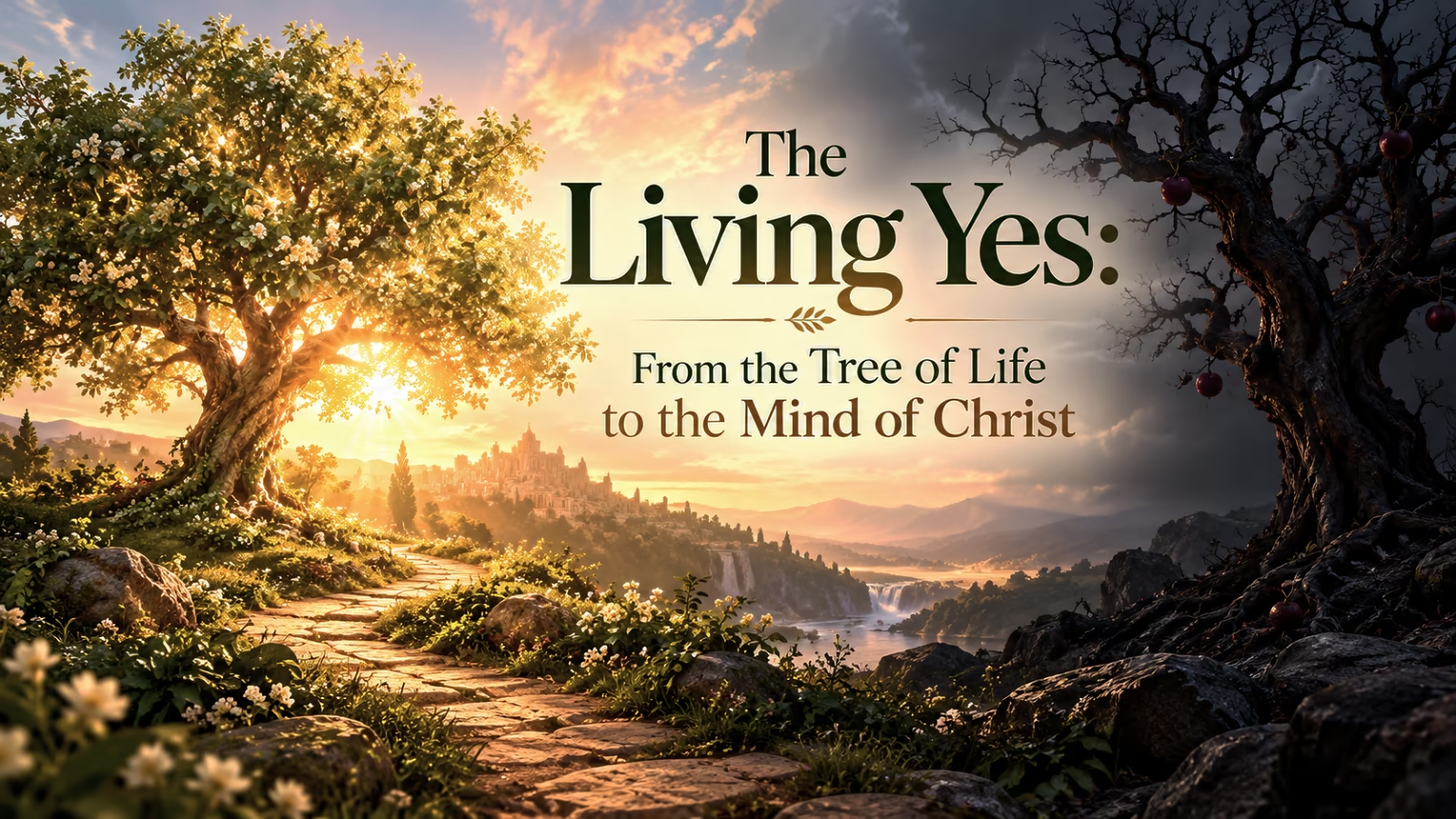
The Living Yes: From the Tree of Life to the Mind of Christ
Why does Paul tell believers in Romans 8 to set their minds on the Spirit, yet in Philippians 4:8 instruct them to think upon whatever is true, honorable, just, pure, lovely, and worthy of praise? Is he describing two approaches to the Christian life, or one living relationship viewed from different directions?
Philippians 4:8 can easily be reduced to positive thinking: reject bad thoughts, choose good thoughts, and become a better person. But Paul is not teaching believers to manufacture goodness through the power of their minds.
Read alongside Romans 8, his words reveal how the mind recognizes what accords with the nature of Christ, remains turned toward His Spirit, and participates in the transformation that comes from His life. The issue is not simply what we know, but the Source from whom we receive truth and life.
Scripture reveals two radically different ways of saying yes. The Living Yes remains in fellowship with Christ, the Truth; the Death Yes takes knowledge into the independent mind and attempts to live from it apart from Him.
Two Trees, Two Sources
In Eden stood the Tree of Life and the Tree of the Knowledge of Good and Evil (Genesis 2:9). They introduce a distinction that unfolds throughout Scripture: life received from God or knowledge sought independently of Him.
Adam and Eve were not ignorant creatures waiting for the serpent to teach them how to think. God had spoken to them, given them responsibilities, and entrusted them with the ability to understand, discern, and choose.
The forbidden tree concerned the knowledge of both good and evil. That matters because what appears good can still be pursued from the wrong source; moral attractiveness alone does not establish agreement with God.
God's command was clear: eating from that tree would bring death (Genesis 2:16–17). His prohibition was not a denial of life but a warning intended to preserve humanity from death.
Then the serpent introduced a claim that could not stand alongside God's word without changing it. He said that they would not surely die (Genesis 3:4).
Eve's Failure and Christ's Answer
Eve knew God's command and repeated it to the serpent. Yet when he presented a different explanation, she proceeded to consider the fruit desirable for food, beauty, and wisdom, and she ate (Genesis 3:2–6).
Her failure was not the exercise of judgment. It was acting without resolving the break the serpent had introduced into God's truth. Rather than accepting the claim or deciding while its truth remained unsettled, she needed to hold fast to what God had spoken and seek His guidance.
Jesus met Satan's deception differently. When Satan quoted Scripture to justify throwing Himself from the temple, Jesus answered with the Scripture that exposed the false application:
“Again it is written, Thou shalt not make trial of the Lord thy God.”
— Matthew 4:7, ASV
Jesus did not allow Satan's quotation of Scripture to pass for a true application. He exposed the break, and Satan moved to another temptation (Matthew 4:8).
Jesus later declared that “the scripture cannot be broken” (John 10:35). A claim is not true simply because it sounds reasonable or quotes a verse; its full meaning must stand within God's unified revelation without omissions, alterations, or invented repairs.
This is what living agreement with God requires. Test what is presented, refuse what breaks His Word, and do not act upon a deception merely because it promises something good.
Truth Is a Living Person
Jesus did not merely claim to teach truth. He said:
“I am the way, and the truth, and the life”
— John 14:6, ASV
The distinction is profound. Knowing true things about Christ is not the same as receiving Christ Himself as life.
Jesus confronted people who searched the Scriptures yet refused to come to Him that they might have life (John 5:39–40). Their attention to the written testimony had not brought them into fellowship with the Person of whom it testified.
Paul describes the difference in 2 Corinthians 3:6:
“for the letter killeth, but the spirit giveth life.”
— 2 Corinthians 3:6, ASV
Paul speaks in the context of the old and new covenants. God's written commandments were not evil, but the letter could not impart the life that the Spirit gives; even the reading of Moses could occur while a veil remained over the heart (2 Corinthians 3:14–16).
The Word is not the problem. The problem is attempting to live by its words without receiving the life of the One to whom they testify. Christ is the bread of life, not simply a subject to be studied (John 6:35, 51).
Romans 7 and 8: The Source of Victory
Romans 7 describes the defeat of someone who knows what is right and wants to do it but discovers another law at work within. The mind can approve what is good, and the will can desire it, without possessing the power to produce it.
Romans 8 announces the answer:
“For the law of the Spirit of life in Christ Jesus made me free from the law of sin and of death.”
— Romans 8:2, ASV
Freedom does not come from stronger resolve, better religious performance, or stricter obedience to outward rules. The law of the Spirit of life in Christ Jesus makes us free.
God's commandments remain true, but behavior cannot manufacture divine life. The Spirit supplies life, and obedience becomes its expression as the believer walks according to Him (Romans 8:3–4).
This changes the believer's response to failure. When we know the command to forgive but find resentment rising within us, the answer is not merely to force ourselves into a convincing display of kindness; we must turn toward the Christ whose life produces forgiveness and freely agree with His truth.
The believer still chooses and acts. But the source of that response is no longer confidence in the independent will; it is dependence upon the Spirit of life.
Setting the Mind on the Spirit
Paul writes:
“For the mind of the flesh is death; but the mind of the Spirit is life and peace:”
— Romans 8:6, ASV
The decisive question is not merely whether a thought appears moral or immoral. Where is the mind turned for truth, direction, and life?
Through the new birth, God gives a new heart and a new spirit and puts His Spirit within His people (Ezekiel 36:26–27). Yet the believer's mind, emotions, and will remain active, and the mind must be renewed (Romans 12:2).
The Spirit does not replace the believer's reasoning or will. Paul declares, “But we have the mind of Christ” (1 Corinthians 2:16), after explaining that God's depths are revealed through His Spirit. The believer consciously sets the mind on the Spirit, discerns, and freely responds.
That brings us back to Philippians 4:8. What does the mind recognize when it turns toward Christ?
Philippians 4:8: Recognizing His Character
Paul directs the believer's attention to what is true, honorable, just, pure, lovely, of good report, virtuous, and worthy of praise:
“Finally, brethren, whatsoever things are true, whatsoever things are honorable, whatsoever things are just, whatsoever things are pure, whatsoever things are lovely, whatsoever things are of good report; if there be any virtue, and if there be any praise, think on these things.”
— Philippians 4:8, ASV
These are not independent ideals from which the human mind must construct a better personality. Read in the light of the whole revelation, they describe qualities consistent with the character of Christ, whom the believer is called to behold.
Christ is the Truth (John 14:6), the Righteous One (1 John 2:1), and pure (1 John 3:3). His character provides the measure by which we recognize what accords with the Spirit rather than simply with human notions of goodness.
The surrounding passage keeps our attention on God. The believer rejoices in the Lord, brings concerns to God in prayer, receives the peace of God to guard heart and thoughts, and then hears Paul's instruction in verse 9: “these things do.”
The mind is neither passive nor left alone with a checklist. It turns toward the living Christ, recognizes what agrees with His nature, and responds to Him in willing action.
James 3 describes wisdom from above as pure, peaceable, gentle, and full of mercy, while Galatians 5 names love, joy, peace, and the other fruit of the Spirit. These passages reinforce the same distinction: the Spirit's life carries a recognizable character.
- Romans 8 tells us where the mind must be set.
- Philippians 4:8 helps us recognize what accords with the One upon whom it is set.
Neither instruction asks the believer to produce that life independently.
Beholding Christ, Not Manufacturing His Fruit
Paul writes that believers, beholding the glory of the Lord, “are transformed into the same image from glory to glory” (2 Corinthians 3:18, ASV). The transformation comes from the Lord, the Spirit—not from the mind imitating a list of divine attributes through independent effort.
Beholding Christ is not imagining what He must be like or waiting passively for a feeling. Through the Scriptures that testify of Him and the Spirit who reveals His truth, the believer turns attention to Christ Himself, recognizes His character, and willingly responds to His light.
The believer beholds Christ, receives His life, and increasingly expresses His nature. Philippians 4:8 is not a substitute for beholding Him; it helps the mind recognize the beauty and purity of the One being beheld.
Jesus gave the clearest picture of this relationship:
“I am the vine, ye are the branches: He that abideth in me, and I in him, the same beareth much fruit: for apart from me ye can do nothing.”
— John 15:5, ASV
A branch does not manufacture fruit by examining what fruit ought to look like. It bears fruit through its living connection to the Vine.
In the same way, the believer does not produce righteousness or love by admiring them or attempting to reproduce them from self. Abiding in Christ is the source; the fruit is the expression of His life.
The Living Yes and the Death Yes
The Death Yes takes a portion of truth, surrounds it with human conclusions, and then treats those conclusions as sufficient apart from Christ. Even when its words are correct, it can cease listening, resist correction, and attempt to produce spiritual life through knowledge or effort.
The Living Yes is not uncertain about what God has established. It can reach firm conclusions, reject error, and hold fast to Scripture, while never confusing its present understanding with the infinite mind of God.
Paul knew Christ with certainty, yet still declared, “that I may know him” (Philippians 3:10). He had been apprehended by Christ, but had not exhausted the depths of the One who apprehended him.
Paul says that God's promises find their Yes in Christ (2 Corinthians 1:19–20). The Living Yes is therefore not something the believer invents, but a continuing agreement with the truth God has established in His Son.
The Living Yes remains teachable without becoming indecisive. It says yes to God's Word, yes to His correction, yes to the leading of His Spirit, and yes to the life that can come only from Christ.
This distinction also reveals why knowledge without love can become destructive. Paul warns that knowledge can puff up while love builds up (1 Corinthians 8:1); when believers remain joined to the same Head, truth becomes the basis for speaking in love rather than claiming superiority (Ephesians 4:15–16).
Living the Yes Today
The Living Yes becomes practical whenever a believer encounters a claim, a temptation, a difficult relationship, or an inward response that must be judged. The question is not merely, What do I already know? but Am I receiving and responding to the truth of Christ now?
When a teaching sounds convincing, we test its full implications against Scripture rather than rushing to agreement. When someone wounds us and anger presses for an immediate reply, we do not assume that the first impulse—or a religious effort to suppress it—expresses the life of Christ.
We hold fast to God's truth, turn toward the Spirit, and recognize in Christ the purity, justice, mercy, and love that our immediate reaction lacks. Then we freely choose our response in fellowship with Him, depending on His life rather than asking independent willpower to manufacture His fruit.
This is not a technique for obtaining spiritual results. It is living fellowship with Christ: hearing, testing, discerning, agreeing, and acting while continuing to receive life from Him.
Yesterday's understanding may remain true, but it cannot replace today's fellowship. Christ called Himself the living bread (John 6:51); He did not offer His people a store of religious conclusions from which they could thereafter live independently.
From the Tree of Life to the Living Yes
Scripture begins with humanity confronted by two trees and ends with the Tree of Life beside the river of the water of life (Revelation 22:1–5). From beginning to end, God never presents independence from Him as the goal of human maturity.
Christ is the Truth and the Life. Through His Spirit, believers receive His life, set their minds upon Him, behold His glory, and are transformed into His image.
The Living Yes is the believer's continual, conscious, and willing agreement with the living Christ. It receives truth without separating it from its Source, exercises discernment without becoming independent, and remains certain of God while continuing to know Him more deeply.
The mind beholds. The believer freely agrees. The Spirit supplies the life.
That is the Living Yes.