

In This Article
Recommended Books
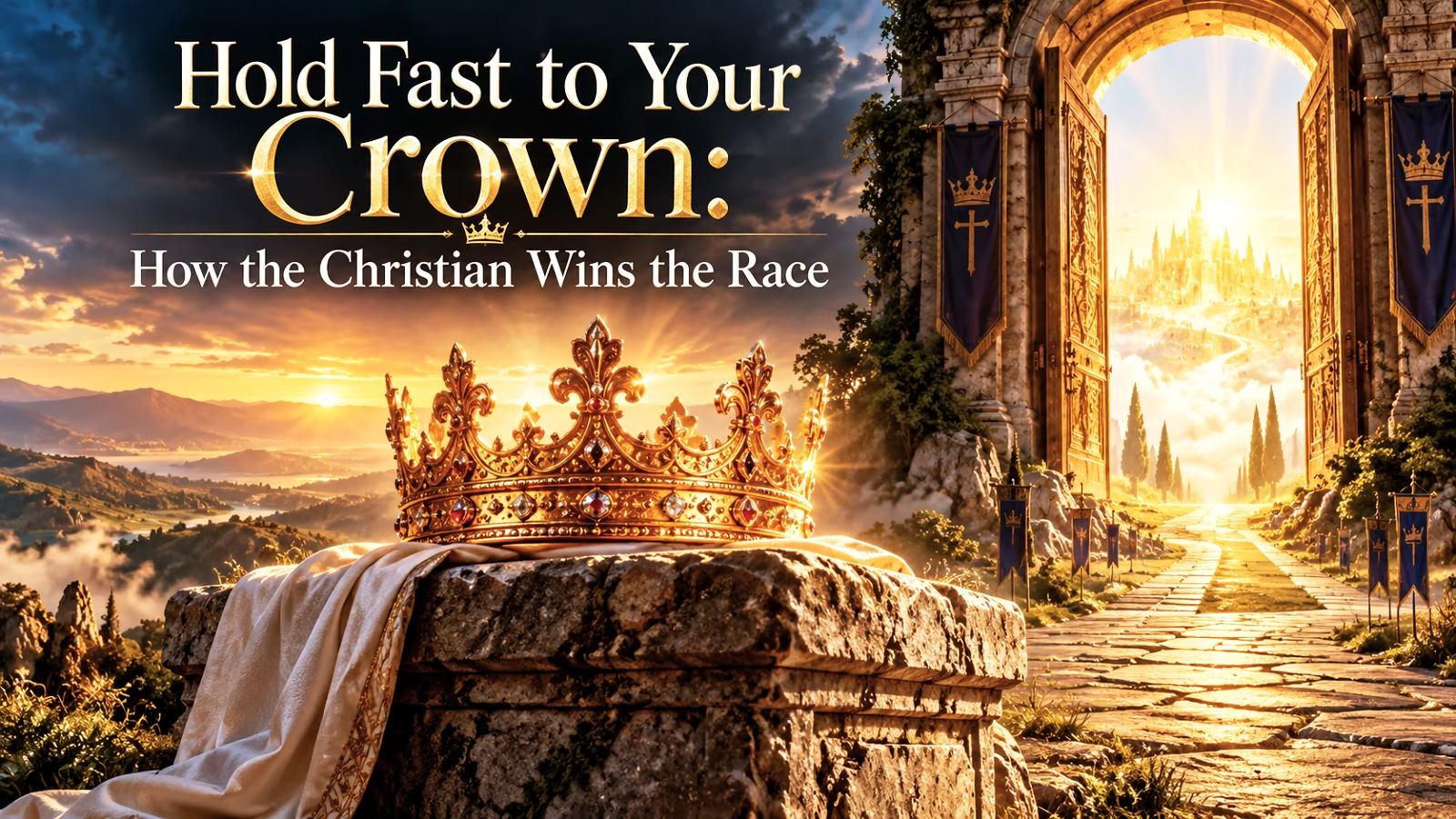
Hold Fast to Your Crown: How the Christian Wins the Race
In Part 1, we established that the Christian life is a real race with a real prize. In Part 2, Christ's promises to the overcomers showed what that prize contains: Kingdom life, intimacy, authority, the crown, and ultimately a place with Christ upon His throne. One question remains.
How does a believer actually overcome?
Jesus does not leave us guessing. In His final messages to the seven churches, He gives us both a positive example and a warning: Philadelphia shows us the path of victory, while Laodicea shows us why human strength cannot get us there.
Philadelphia: A Church Christ Did Not Rebuke
Five of the seven churches receive serious correction from Christ. Philadelphia does not.
Instead, Jesus says:
“I know thy works (behold, I have set before thee a door opened, which none can shut), that thou hast a little power, and didst keep my word, and didst not deny my name.”
Revelation 3:8, ASV
Notice what Christ commends in Philadelphia:
- a little power,
- kept His word,
- did not deny His name,
- and kept the word of His patience.
They were not praised for impressive human strength, great outward power, or religious success. They had “a little power.” Yet Christ found no fault with them.
That immediately tells us something important about winning the race: victory does not depend upon having great human strength. Philadelphia had little power, but they kept Christ's word. They had little power, but they did not deny His name.
They had little power, but they endured. And Christ approved them.
Philadelphia Is the Church of Brotherly Love
The name Philadelphia means brotherly love, and that should not be ignored when considering the spiritual condition of the one church Christ does not rebuke. Where Christ's life governs His Body, love for the brethren and unity follow.
Before going to the cross, Jesus prayed:
“that they may all be one; even as thou, Father, art in me, and I in thee, that they also may be in us: that the world may believe that thou didst send me.”
John 17:21, ASV
Philadelphia stands as a living answer to that prayer. It is the church of brotherly love, keeping Christ's word, refusing to deny His name, and remaining faithful under pressure. Christ finds nothing there requiring correction.
That does not mean Philadelphia was powerful by worldly measurements. Christ Himself says they had “a little power.” But they had what mattered.
What Philadelphia Had
The way of Philadelphia can be stated plainly:
- Keep Christ's word.
- Do not deny His name.
- Remain faithful through suffering and pressure.
- Walk in brotherly love and the unity of His Body.
- Do not follow the failures Christ exposed in the other churches.
That last point matters. Ephesus had works and endurance but had left its first love. Pergamum and Thyatira tolerated corruption and compromise.
Sardis had a name that it lived, but Christ called it dead. Laodicea had become lukewarm and self-satisfied. Philadelphia was not traveling those roads.
Hold Fast That No One Take Thy Crown
After commending Philadelphia, Christ gives them a striking command:
“I come quickly: hold fast that which thou hast, that no one take thy crown.”
Revelation 3:11, ASV
They were already on the right path. Christ did not tell them to discover some new method. He told them to hold fast to what they already had.
Do not leave the path. Do not surrender what Christ has produced. Do not allow the failures found in the other churches to enter.
Hold fast.
Why?
Because the crown can be lost.
The same Christ who gives eternal life freely tells His saints to guard what they have so that no one takes their crown. Salvation and the crown cannot therefore be the same thing. The believer does not hold fast in order to remain God's child.
He holds fast because there is a race to finish and a crown to obtain.
Laodicea Reveals the Opposite Path
Philadelphia had little power and received no rebuke. Laodicea believed it needed nothing and received one of Christ's strongest rebukes. That contrast is difficult to miss.
Christ says to Laodicea:
“Because thou sayest, I am rich, and have gotten riches, and have need of nothing; and knowest not that thou art the wretched one and miserable and poor and blind and naked.”
Revelation 3:17, ASV
Philadelphia knew weakness and remained faithful to Christ. Laodicea had become confident in its own condition. That is one of the great dangers in the Christian race: thinking we possess what only continued dependence upon Christ can supply.
The victorious life is not produced by religious confidence. It is not produced by reputation. It is not produced by knowledge alone.
It is not produced by human determination. Laodicea thought it had enough. Christ said it was poor.
Christ Stands at the Door
What Christ says next reveals the heart of overcoming.
“As many as I love, I reprove and chasten: be zealous therefore, and repent. Behold, I stand at the door and knock: if any man hear my voice and open the door, I will come in to him, and will sup with him, and he with me.
“He that overcometh, I will give to him to sit down with me in my throne, as I also overcame, and sat down with my Father in his throne.”
Revelation 3:19–21, ASV
Christ does not expose Laodicea's failure and then abandon them to solve it by themselves. He comes to the door. He knocks.
He speaks. The believer's responsibility is to hear His voice and open the door. The promise of the throne comes immediately after the invitation to fellowship.
That connection is profound. Christ is not saying, “Try harder until you become victorious.”
He is saying, in effect:
Hear Me. Open the door. Let Me in.
Christ Comes to His People Through the Spirit
Jesus had already explained how He would come to His people after His departure.
He said:
“And I will pray the Father, and he shall give you another Comforter, that he may be with you for ever, even the Spirit of truth: whom the world cannot receive; for it beholdeth him not, neither knoweth him: ye know him; for he abideth with you, and shall be in you.
“I will not leave you desolate: I come unto you.”
John 14:16–18, ASV
Jesus promises the Comforter, the Spirit of truth, and then immediately says:
“I come unto you.” He does not present the coming of the Spirit as though Christ were now absent from His people. He promises the Spirit and, in the same breath, declares that He Himself will come to them.
Jesus continues:
“But the Comforter, even the Holy Spirit, whom the Father will send in my name, he shall teach you all things, and bring to your remembrance all that I said unto you.”
John 14:26, ASV
And again:
“Howbeit when he, the Spirit of truth, is come, he shall guide you into all the truth.”
John 16:13, ASV
This is how the believer is led through the race. The Spirit teaches. The Spirit reminds us of Christ's words.
The Spirit guides into truth. Through the Spirit, the living Christ is present with His people and leads them. So when Christ says, “I stand at the door and knock,” the answer is not to produce more human strength.
The answer is to open the door.
Human Strength Cannot Win the Race
Romans 7 exposes what happens when a person attempts to fulfill God's purpose through the strength of the self.
Paul describes the conflict:
“For I know that in me, that is, in my flesh, dwelleth no good thing: for to will is present with me, but to do that which is good is not.”
Romans 7:18, ASV
The desire can be present while the power is absent. That is why simply deciding to become victorious is not enough. Human determination cannot produce the life of Christ.
Religious effort cannot manufacture spiritual maturity. Self-discipline has its proper place, but it cannot substitute for the living operation of Christ within His people.
Romans 8 gives the answer:
“For the law of the Spirit of life in Christ Jesus made me free from the law of sin and of death.”
Romans 8:2, ASV
The answer to the weakness exposed in Romans 7 is the Spirit of life in Christ Jesus. That is why Philadelphia's “little power” was not a disqualification. Their victory did not rest upon the greatness of their natural ability.
It rested upon faithfulness to Christ.
Listen Before You Work
The story of Mary and Martha gives us a simple picture of the same principle. Martha was busy serving. Mary was sitting at Jesus' feet and listening.
When Martha objected, Jesus answered:
“Martha, Martha, thou art anxious and troubled about many things: but one thing is needful: for Mary hath chosen the good part, which shall not be taken away from her.”
Luke 10:41–42, ASV
Martha was doing things for Jesus. Mary was listening to Jesus. That order matters.
Christian activity cannot replace hearing Christ. Service cannot substitute for fellowship. Work for the Lord cannot replace sitting before the Lord.
Mary chose the good part because she placed herself where she could hear Him.
That is the same call repeated throughout Revelation 2 and 3:
“He that hath an ear, let him hear what the Spirit saith to the churches.”
Hear What the Spirit Says to the Churches
Every message to the seven churches demands hearing. That means Christ's warnings are not merely descriptions of other Christians somewhere else. Ephesus asks whether we have left our first love.
Pergamum and Thyatira ask what compromise we have tolerated. Sardis asks whether our reputation exceeds our spiritual reality. Laodicea asks whether we have become self-satisfied while Christ stands outside the door.
Philadelphia shows another way. Keep His word. Do not deny His name.
Remain patient. Walk in brotherly love. Hold fast.
And above all, hear what the Spirit is saying.
The Way to Victory Is Living Fellowship With Christ
Christ never commands His children to overcome and then withholds the means of victory. He is standing at the door. The Comforter has been given.
The Spirit of truth teaches and guides. The Spirit of life operates in Christ Jesus. The believer must still choose.
Christ knocks, but the door must be opened. Christ speaks, but His voice must be heard. The Spirit leads, but the believer must follow.
That is why overcoming is neither passive nor self-produced. It is the believer actively responding to Christ in living fellowship with Him.
From the Open Door to the Throne
Look again at the order of Christ's words to Laodicea.
First:
“I stand at the door and knock.”
Then:
“if any man hear my voice and open the door, I will come in to him.”
And finally:
“He that overcometh, I will give to him to sit down with me in my throne.” The path runs from hearing, to opening, to fellowship, to overcoming, to the throne. That is not accidental.
The throne is the prize, but fellowship with Christ is the way there.
Finish the Race
Paul began with the race:
Run that you may attain.
Christ tells Philadelphia:
Hold fast that no one take thy crown.
And to Laodicea He says:
Open the door. Taken together, the message is remarkably clear. Do not rely upon your own strength.
Do not assume religious activity equals victory. Do not allow compromise, spiritual pride, lost love, or self-satisfaction to turn you from the course. Keep Christ's word.
Do not deny His name. Love the brethren. Endure.
Listen to the Spirit. Open the door to the living Christ. Follow Him.
The believer who does this is not trying to earn eternal life. Eternal life is God's gift in Christ. He is running because Christ has placed a prize before him.
There is a crown that can be gained. There is a crown that can be lost. There is a Kingdom ahead.
There is a throne. And Christ Himself is standing at the door.
Let Him in. Hear what the Spirit is saying. Follow the living Christ, and let Him lead you to your crown, your prize, and into the Kingdom.