

In This Article
Recommended Books
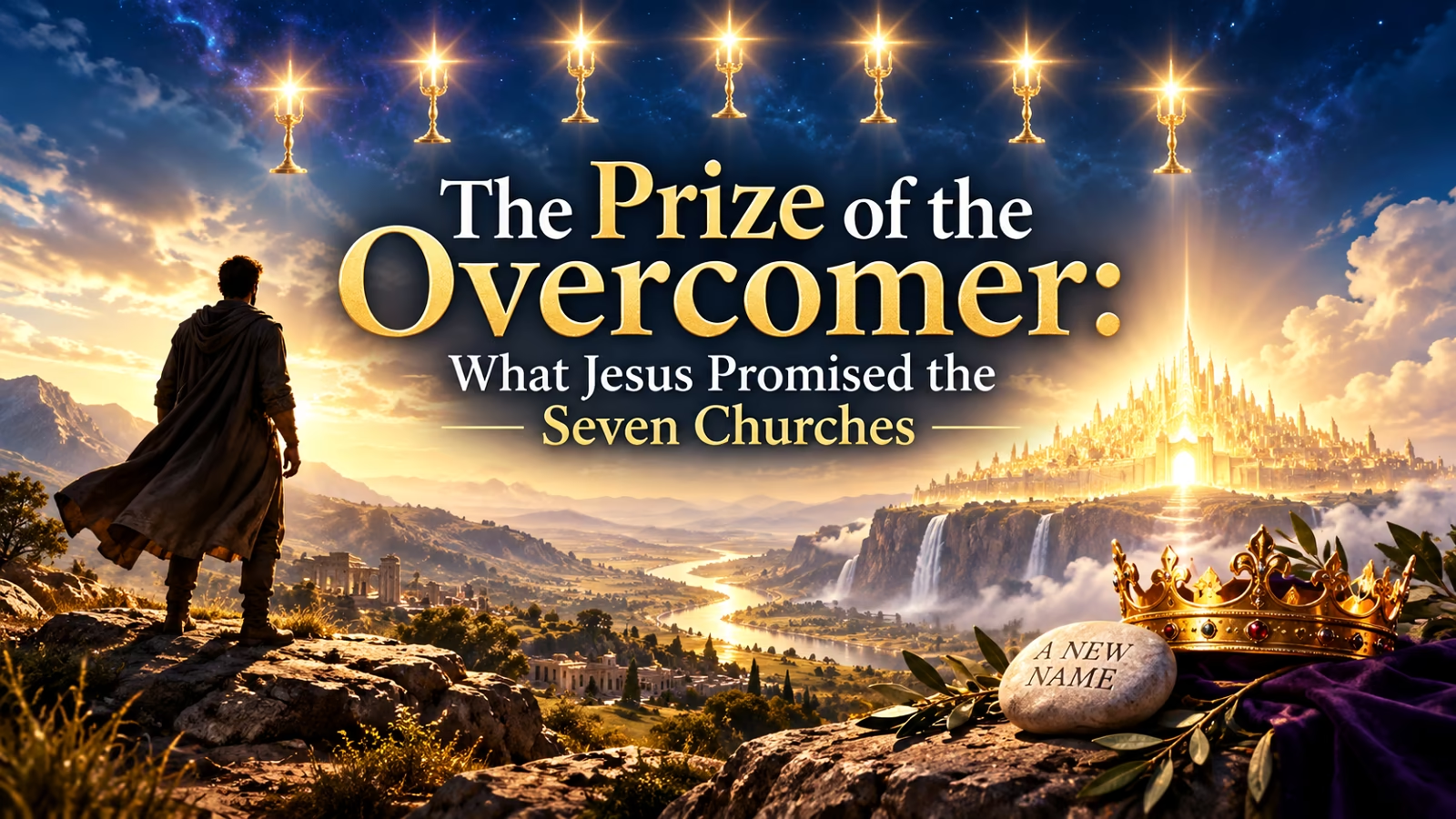
The Prize of the Overcomer: What Jesus Promised the Seven Churches
In Part 1, we established that Paul was not running to obtain salvation. He already belonged to Christ, yet he still disciplined himself because he knew he could be disqualified from the prize.
First Corinthians 3 gave us the controlling distinction: a believer can suffer loss and still be saved. The question now becomes more specific: What exactly can the victorious believer gain, and what can the defeated believer lose?
Jesus answers that question in Revelation 2 and 3.
Christ Defines the Prize
The risen Christ addresses seven churches, and He repeatedly ends His messages with a promise to “him that overcometh.” These promises are not given merely to people who call themselves Christians; they are attached specifically to victory.
The distinction matters. If every believer automatically receives everything Christ specifically promises to the overcomer, then the condition loses its meaning and the warnings to the defeated become empty.
Throughout these messages, Jesus progressively reveals what is at stake:
- access to the Tree of Life,
- protection from the second death,
- hidden manna,
- a white stone and new name,
- authority over the nations,
- the Morning Star,
- white garments,
- continued standing in the Book of Life,
- a crown,
- a permanent place associated with God's temple and name,
- and a place with Christ on His throne.
These are not decorative rewards added to salvation. Together they reveal the substance of the Kingdom prize.
Access to the Tree of Life
Christ's first promise to the overcomer immediately reaches beyond anything believers presently experience during the Age of Grace.
“He that hath an ear, let him hear what the Spirit saith to the churches. To him that overcometh, to him will I give to eat of the tree of life, which is in the Paradise of God.”
Revelation 2:7, ASV
The Tree of Life appears again in the New Jerusalem, where God's redeemed people ultimately enjoy its life without the divisions of reward and loss that still exist during the Kingdom Age.
That means the promise in Revelation 2 cannot refer to final, eternal exclusivity. In the New Jerusalem, the Tree of Life is not reserved for only one class of God's children.
The promise therefore concerns early access.
During the Kingdom Age, the victorious enter into an enjoyment of the Paradise of God and the Tree of Life that the defeated do not yet share. The pattern recalls Eden, where access to the Tree of Life could be lost without Adam and Eve ceasing to be human beings created by God.
The distinction is real.
The victorious enjoy the Tree of Life during the Kingdom. The defeated do not.
Escape From the Second Death
Christ's next promise is far more severe.
“He that hath an ear, let him hear what the Spirit saith to the churches. He that overcometh shall not be hurt of the second death.”
Revelation 2:11, ASV
Jesus does not merely promise the victorious believer an additional blessing. He promises that the overcomer will not be hurt by something terrible.
The promise has distinguishing force.
If the defeated believer could never under any circumstances be hurt by the second death, then Christ's promise specifically to the overcomer would distinguish nothing. The warning would collapse into a protection automatically possessed by victorious and defeated alike.
Christ's words do not permit that.
The defeated believer will experience something of the second death, while the victorious will not be hurt by it.
That cannot mean permanent destruction or eternal loss of salvation. First Corinthians 3 has already established another category: saved, yet suffering loss.
Revelation 20 strengthens the connection:
“Blessed and holy is he that hath part in the first resurrection: over these the second death hath no power; but they shall be priests of God and of Christ, and shall reign with him a thousand years.”
Revelation 20:6, ASV
Here protection from the second death appears in direct connection with reigning with Christ for a thousand years.
The timing is not accidental.
The Hidden Manna, the White Stone, and the New Name
Christ next promises something deeply personal.
“He that hath an ear, let him hear what the Spirit saith to the churches. To him that overcometh, to him will I give of the hidden manna, and I will give him a white stone, and upon the stone a new name written, which no one knoweth but he that receiveth it.”
Revelation 2:17, ASV
The manna given to Israel sustained the whole nation in the wilderness. Yet God also commanded that a portion be preserved before Him, and Hebrews later places that preserved manna with the Ark.
The manna eaten by all Israel sustained the people openly. The preserved manna was associated with the innermost place of God's dwelling.
That distinction gives force to Christ's words “the hidden manna.”
The promise points toward a concealed and reserved portion of Christ—a special experience of Him associated with nearness to God.
The white stone and the new name make the promise even more personal. The name is known only by the one receiving it.
This is not merely public recognition.
It describes something one-on-one with Christ: a personal intimacy, recognition, and nearness belonging to the victorious during the Kingdom Age.
The defeated do not cease belonging to Christ, but they lose that privileged experience for the thousand years.
Authority Over the Nations
With Thyatira, the governmental nature of the prize becomes unmistakable.
“And he that overcometh, and he that keepeth my works unto the end, to him will I give authority over the nations: and he shall rule them with a rod of iron, as the vessels of the potter are broken to shivers; as I also have received of my Father: and I will give him the morning star.”
Revelation 2:26–28, ASV
This cannot describe the present Age of Grace. Christians are not presently ruling the nations with a rod of iron.
Neither can it describe a privilege restricted to only some believers forever in the New Jerusalem, where God's redeemed work has reached its completed expression.
The promise belongs to the Kingdom Age.
The victorious share in Christ's governmental authority over the nations because they have been prepared to reign with Him.
Paul says the same thing:
“if we endure, we shall also reign with him: if we shall deny him, he also will deny us.”
2 Timothy 2:12, ASV
The condition is endurance.
A believer who refuses Christ's present work cannot simply be handed the same Kingdom responsibility as the believer who endured, overcame, and remained faithful to the end.
The Morning Star
Christ adds another extraordinary promise:
“I will give him the morning star.”
Revelation later identifies the Morning Star:
“I am the root and the offspring of David, the bright, the morning star.”
Revelation 22:16, ASV
The Morning Star is Christ Himself.
The victorious therefore receive more than governmental responsibility. They receive an early and special experience of Christ Himself during the Kingdom Age.
This is what begins to emerge throughout the promises: the prize is not merely position; it is privileged participation in Christ.
White Garments and the Book of Life
The warning becomes still more serious in Christ's message to Sardis.
“He that overcometh shall thus be arrayed in white garments; and I will in no wise blot his name out of the book of life, and I will confess his name before my Father, and before his angels.”
Revelation 3:5, ASV
Again, the promise must retain its distinguishing meaning.
The victorious are clothed in white. Their names remain in the Book of Life, and Christ confesses them before His Father and the angels.
The defeated therefore do not receive those things at that time.
Their names are blotted from the Book of Life for the Kingdom Age, and they are not clothed in the white garments granted to the victorious.
That sounds severe because it is severe.
The Book of Life and Kingdom Citizenship
Paul describes believers as citizens of heaven and members of God's household, and he says that God has transferred us into the Kingdom of His Son.
The Book of Life functions as the registry of that Kingdom citizenship.
During the present Age of Grace, a person born of the Spirit belongs to Christ and stands within that citizenship. At the Judgment Seat, however, the victorious and defeated are distinguished for the coming Kingdom Age.
For the defeated believer, blotting from the Book of Life means loss of Kingdom citizenship for that age.
That does not mean Christ eternally loses one of His own.
Jesus said concerning His sheep:
“and I give unto them eternal life; and they shall never perish, and no one shall snatch them out of my hand.”
John 10:28, ASV
He also said that He would lose nothing the Father had given Him.
Therefore the blotting cannot extend eternally into the New Jerusalem. The thousand-year Kingdom provides the period in which Christ's warning can retain its full force while His eternal salvation remains secure.
The loss is real.
The loss is devastating.
But it is Kingdom loss, not eternal loss of Christ.
Hold Fast That No One Take Thy Crown
To Philadelphia, a church against which Christ gives no rebuke, He speaks directly about the crown.
“I come quickly: hold fast that which thou hast, that no one take thy crown. He that overcometh, I will make him a pillar in the temple of my God, and he shall go out thence no more: and I will write upon him the name of my God, and the name of the city of my God, the new Jerusalem, which cometh down out of heaven from my God, and mine own new name.”
Revelation 3:11–12, ASV
Christ does not say merely, “You have a crown.”
He says:
“Hold fast... that no one take thy crown.”
The crown can be lost.
That statement reaches directly back to Paul's warning in 1 Corinthians 9. Paul ran for an incorruptible crown and disciplined himself because he knew disqualification was possible.
Christ now tells a faithful church the same essential thing: do not let anyone take what is ahead of you.
The crown is therefore not automatic simply because someone belongs to Christ.
Christ connects victory with remarkable privileges: permanence, identification with God, identification with the New Jerusalem, and His own new name.
The victorious receive an early Kingdom experience of realities that will ultimately characterize the completed New Jerusalem.
That does not make the New Jerusalem itself the prize.
It means the overcomer receives ahead of time what the defeated must wait to experience until God's work is complete.
Sit With Me on My Throne
Christ's final promise to the seven churches brings the entire matter to its highest point.
“He that overcometh, I will give to him to sit down with me in my throne, as I also overcame, and sat down with my Father in his throne.”
Revelation 3:21, ASV
The prize reaches all the way to Christ's throne.
The victorious believer does not merely enter the Kingdom. He shares in Christ's reign.
This is the same thread Paul followed:
- run to obtain the prize,
- endure in order to reign,
- finish the course,
- receive the crown.
Revelation does not replace Paul's teaching.
It opens it up.
The crown represents approval, but the prize itself is far greater: participation with Christ in His Kingdom glory, government, intimacy, life, and throne.
Why These Promises Must Belong to the Kingdom Age
The timing now becomes unavoidable.
These promises cannot find their distinguishing fulfillment during the present Age of Grace, because believers are not presently ruling the nations, sitting with Christ upon His Kingdom throne, or receiving the other promised consequences following the Judgment Seat.
They also cannot function as the prize in the New Jerusalem because God's redeemed children will then have reached the completed purpose of God.
The Kingdom Age stands between the two.
It is the only period in which the victorious can receive these privileges while the defeated suffer their corresponding loss.
That is why Christ's promises have real meaning.
The victorious gain:
- early access to the Tree of Life,
- protection from the second death,
- hidden manna and personal intimacy,
- authority over the nations,
- Christ as the Morning Star,
- white garments,
- continued Kingdom citizenship,
- the crown,
- special identification with God and the New Jerusalem,
- and a place with Christ upon His throne.
The defeated remain Christ's redeemed children, but they lose these Kingdom privileges for the thousand years.
That is the prize Paul feared losing.
The Question Now Changes
Once we see what Christ actually promises the overcomer, another question becomes urgent.
How does a believer overcome?
Christ does not merely tell His churches what they can lose. He also shows them what victory looks like.
Philadelphia receives no rebuke and is told simply to hold fast. Laodicea, by contrast, hears Christ standing at the door and knocking.
Those two churches bring us to the practical heart of the race.
The question is no longer merely, “What is the prize?”
It is:
“How do I finish the race and obtain it?”
That is where Part 3 begins.
Part 3: Hold Fast to Your Crown — How the Christian Wins the Race