

In This Article
Recommended Books
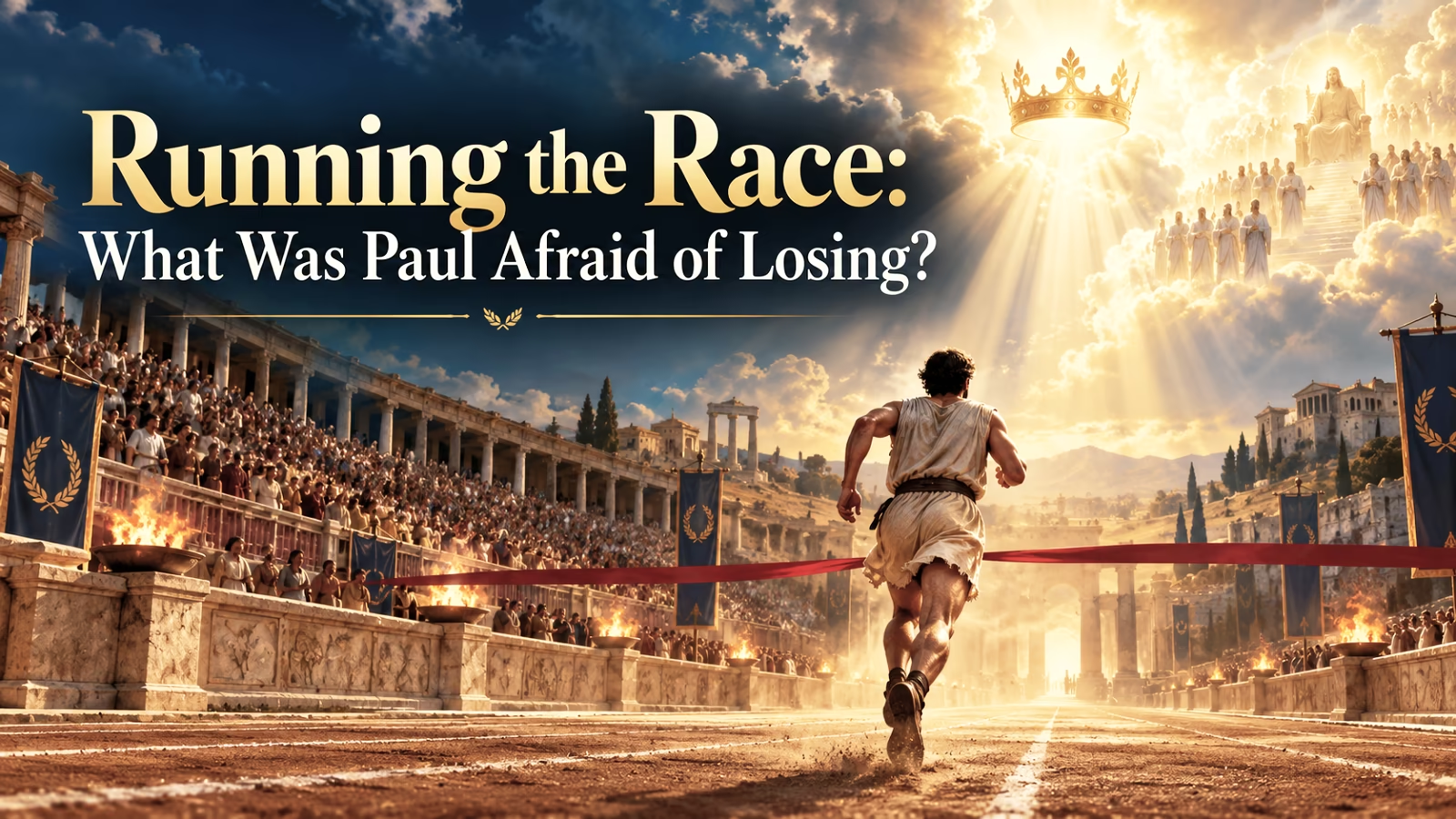
Running the Race: What Was Paul Afraid of Losing?
The Apostle Paul made a statement in 1 Corinthians that every Christian should take seriously. He described the Christian life as a race with a prize at the end—and then warned that even he could be disqualified from receiving it.
“Know ye not that they that run in a race run all, but one receiveth the prize? Even so run; that ye may attain. And every man that striveth in the games exerciseth self-control in all things. Now they do it to receive a corruptible crown; but we an incorruptible.
“I therefore so run, as not uncertainly; so fight I, as not beating the air: but I buffet my body, and bring it into bondage: lest by any means, after that I have preached to others, I myself should be rejected.”
1 Corinthians 9:24–27, ASV
These are sobering words coming from an Apostle chosen directly by Jesus Christ. Paul had received the gospel from the Lord, preached Christ throughout the Roman world, suffered for His testimony, planted churches, and was being used by God to write Scripture.
Yet Paul still believed he could be rejected—disqualified from the prize.
Disqualified from what?
That question opens an important thread running throughout the New Testament. Paul was not running to become a child of God; he already belonged to Christ.
He was running because there was something ahead of him that could either be obtained or lost.
Salvation Is a Gift; the Prize Must Be Attained
The first distinction must be made clearly: salvation and the prize are not the same thing.
Salvation is God's gift. The prize is something Paul tells believers to run in order to attain.
Those two things cannot be made identical without breaking Paul's argument.
If Paul were running in order to obtain salvation, then salvation would no longer rest entirely upon Christ's finished work. A believer would have to begin by grace and then successfully complete a race in order to remain saved.
That is not the gospel Paul preached.
Paul's own language establishes the distinction:
- Salvation is received by grace.
- The race is run after we belong to Christ.
- The prize must be attained.
- The believer can suffer loss without ceasing to be saved.
First Corinthians 3 makes that last point unmistakable.
Saved, Yet Suffering Loss
Paul describes believers building upon the foundation that has already been laid—Jesus Christ. He then explains that the quality of each believer's work will eventually be tested.
“But if any man buildeth on the foundation gold, silver, costly stones, wood, hay, stubble; each man's work shall be made manifest: for the day shall declare it, because it is revealed in fire; and the fire itself shall prove each man's work of what sort it is.
“If any man's work shall abide which he built thereon, he shall receive a reward. If any man's work shall be burned, he shall suffer loss: but he himself shall be saved; yet so as through fire.”
1 Corinthians 3:12–15, ASV
Paul could hardly have stated the distinction more clearly.
The man's work can be burned. He can suffer loss.
Yet Paul immediately says:
“He himself shall be saved.”
The loss therefore cannot be salvation. But neither can we make the loss meaningless, because Scripture just as plainly says that he shall suffer loss.
Both truths must stand without weakening either one:
- The believer remains saved.
- The believer can suffer real loss.
This is exactly what Paul's warning in 1 Corinthians 9 requires. He could belong completely to Christ and still fail to obtain the prize for which he was running.
The race is therefore real because the possibility of loss is real. A prize that every believer automatically receives simply because he entered the race would no longer be the prize Paul describes.
The Race Ends at the Judgment Seat of Christ
A race has a finish line, and Scripture tells us where the believer's running will be evaluated.
“For we must all be made manifest before the judgment-seat of Christ; that each one may receive the things done in the body, according to what he hath done, whether it be good or bad.”
2 Corinthians 5:10, ASV
Notice Paul's words: “we must all.”
Paul includes himself. Every child of God will appear before Christ and give account for the life lived after receiving God's salvation.
This is not the Great White Throne judgment of Revelation 20:11–15. That judgment occurs after the thousand-year Kingdom and belongs to a different moment in God's purpose.
The Judgment Seat of Christ concerns Christ's own household.
No one's sin debt is being placed back upon him there. To do so would deny the finished work of Christ, who paid that debt in full.
The question is not whether Christ's blood was sufficient.
The question is what each believer did with the life, opportunity, grace, truth, and responsibility entrusted to him.
Reward and Loss Must Be Decided Before the Kingdom
The Judgment Seat cannot be reduced to a ceremony in which every believer receives essentially the same outcome. First Corinthians 3 explicitly gives us two outcomes: reward and loss.
That judgment must occur before the Kingdom because the prize itself concerns the believer's place in the Kingdom that follows.
Christ gathers His children to Himself in the air, and there His household is judged. Reward and loss are determined before He establishes His Kingdom rule upon the earth.
The sequence matters.
The race is run now. The race is judged when Christ returns. The consequences of that judgment are experienced in the Kingdom that follows.
That is why Paul took his own race so seriously.
Being Used by God Does Not Guarantee the Crown
Paul did not treat his apostleship as a guarantee of approval.
He did not say, “God uses me, therefore I must be qualified.”
He did not say, “I preach to others, therefore my crown is secure.”
Instead he disciplined himself precisely because he understood that public ministry does not automatically equal personal qualification.
A man can preach to others and still fail to finish his own race.
Even an Apostle chosen directly by Jesus could not presume upon his calling. That should sober every Christian.
What, Then, Is the Prize?
If salvation cannot be lost, Paul's warning forces us to ask a different question:
What can a saved believer actually lose?
The New Testament repeatedly connects endurance, overcoming, crowns, authority, reigning, and the coming Kingdom. These are not unrelated teachings accidentally scattered through different books.
They form one unfolding picture.
Paul writes:
“if we endure, we shall also reign with him: if we shall deny him, he also will deny us.”
2 Timothy 2:12, ASV
Reigning with Christ is connected to endurance.
That is the language of the race.
Revelation later places that reigning within a specific period:
“Blessed and holy is he that hath part in the first resurrection: over these the second death hath no power; but they shall be priests of God and of Christ, and shall reign with him a thousand years.”
Revelation 20:6, ASV
Here the Kingdom comes clearly into view.
The prize Paul pursued concerns qualification for participation with Christ in His coming Kingdom reign.
Salvation gives the believer eternal life in Christ. The prize concerns the position granted after the race has been judged.
Where the Kingdom Fits
There is an important chronological fact that brings the picture together.
Between the present Age of Grace and the final New Jerusalem stands the thousand-year Kingdom of Christ.
That thousand-year period is not an unnecessary interruption in God's purpose. It is the very period in which the distinction between victory and defeat, crown and loss, reigning and exclusion can have its full meaning.
The sequence is coherent:
- Now: the believer runs.
- At Christ's return: the believer is judged.
- During the Kingdom: the prize or the loss becomes reality.
- After the Kingdom: God's purpose reaches its completed expression in the New Jerusalem.
This is why the prize cannot simply be another name for salvation.
It is also why the prize cannot be the New Jerusalem itself.
The New Jerusalem Cannot Be the Prize
The New Jerusalem is God's completed habitation. By that time, His redeemed people have been brought to the completion of His eternal purpose.
Revelation describes a condition in which death, mourning, crying, and pain are gone. God's habitation is complete, and His redeemed household is no longer divided between those presently enjoying reward and those suffering loss.
If the New Jerusalem itself were the prize, then the believer who failed to obtain the prize would have to remain eternally outside God's completed habitation.
But that would turn Paul's “suffer loss” into eternal loss, while Paul explicitly says the man “himself shall be saved.”
It would also make the race impossible to understand. If every saved believer eventually enters the New Jerusalem—and Scripture's final picture requires the completion of God's redeemed people—then entrance into that final city cannot be the temporary, conditional prize for which Paul ran.
The prize must be something that can actually be lost while salvation remains secure.
The thousand-year Kingdom provides exactly that period.
The victorious can receive the crown, reign with Christ, and enter the privileges promised to the overcomers, while the defeated can suffer genuine loss without Christ ultimately losing those who belong to Him.
This preserves both sides of Scripture without weakening either one:
Salvation is secure.
The loss is real.
Paul Eventually Finished the Race
Near the end of Paul's life, something remarkable happened to his language.
In 1 Corinthians, Paul said he disciplined himself lest he be rejected from the prize. He was still running.
Years later, shortly before his death, he could finally say:
“I have fought the good fight, I have finished the course, I have kept the faith: henceforth there is laid up for me the crown of righteousness, which the Lord, the righteous judge, shall give to me at that day; and not to me only, but also to all them that have loved his appearing.”
2 Timothy 4:7–8, ASV
Paul had finished.
The man who once said, “lest... I myself should be rejected,” could now say, “I have finished the course.”
And only after saying that does he speak with confidence about the crown laid up for him.
That progression is powerful.
Paul did not begin the race assuming the crown was automatically his because he was saved. He ran, disciplined himself, endured, kept the faith, and reached the point where he could finally say that the course was complete.
The warning of 1 Corinthians 9 and the confidence of 2 Timothy 4 belong together.
Paul feared losing the prize because the prize could truly be lost.
He later expected the crown because he had truly finished the race.
Every Christian Is in This Race
Paul's warning was never intended only for apostles.
He begins by telling the Corinthians:
“Even so run; that ye may attain.”
Every believer has already received something human effort could never earn: life in Jesus Christ.
But receiving life places us at the beginning of the race, not at its finish.
The question is not whether Christ is sufficient to save us.
He is.
The question is whether we will run the race set before us.
Will we listen to Him?
Will we endure?
Will we overcome?
Will we allow His life to transform us, or will we resist His work while presuming that being saved makes the race irrelevant?
Paul refused that presumption.
He knew salvation by grace did not erase accountability. He knew that being used by God did not guarantee the crown, and he knew that one day Christ Himself would determine who had finished faithfully and who had suffered loss.
That distinction leads directly to the words of Jesus to the seven churches in Revelation.
Again and again Christ says:
“To him that overcometh...”
Those promises reveal in remarkable detail what the Kingdom prize actually contains—and what the defeated believer stands to lose.
That is where we will turn next.
Part 2: The Prize of the Overcomer — What Jesus Promised the Seven Churches