


In This Article
Recommended Books
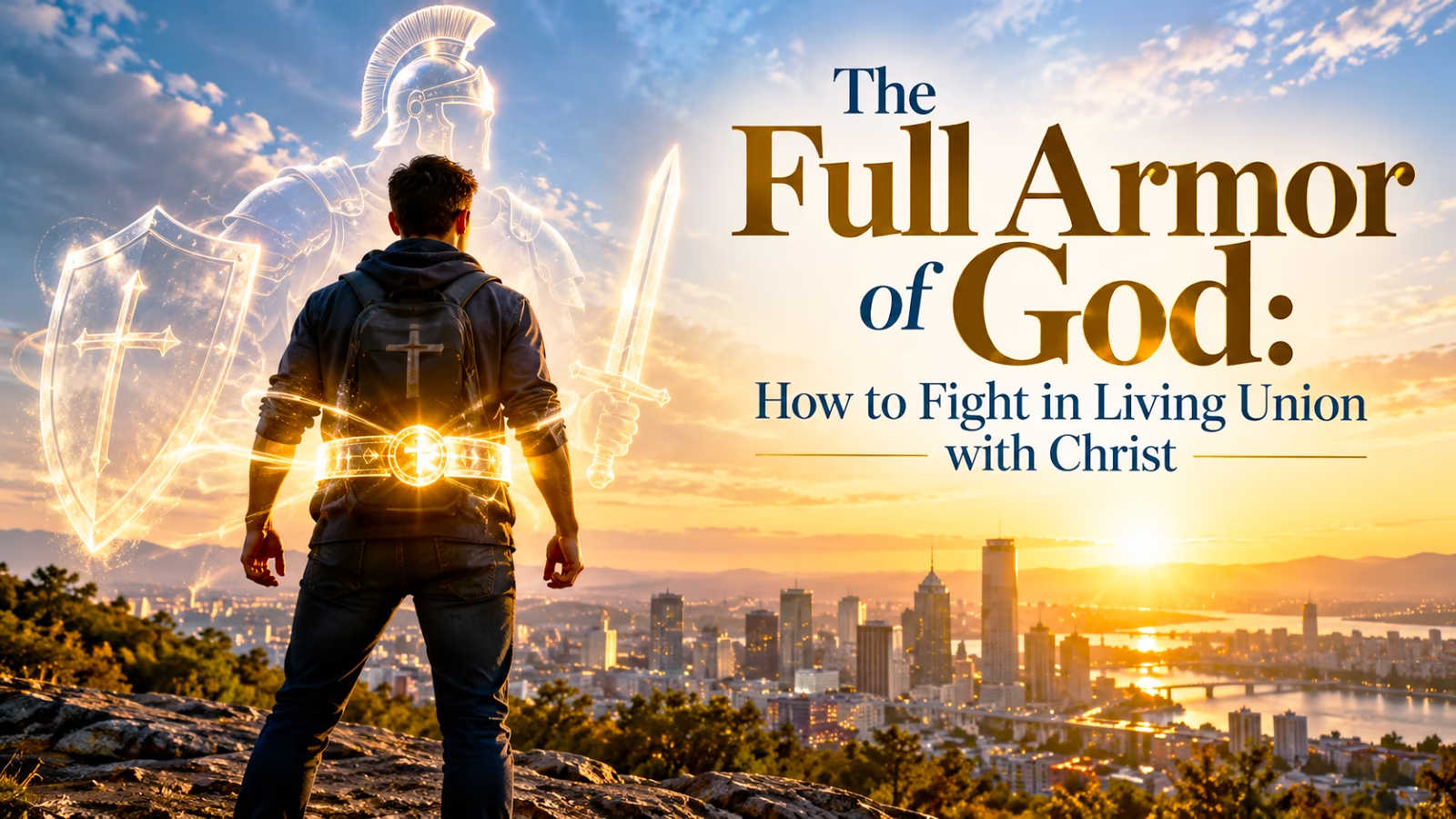
The Full Armor of God: How to Fight in Living Union with Christ
Satan does not need to persuade a Christian to reject the Bible outright. In the wilderness, he quoted Scripture to the Son of God, using a genuine promise to urge an act of disobedience. The words were biblical; the conclusion was a lie.
That confrontation exposes the danger facing every believer: knowing verses is not the same as knowing the truth. If we fight with quotations detached from the mind of Christ, we may be carrying what looks like a sword but has none of the sword of the Spirit's power.
Paul's command is not to admire a soldier's equipment, but to fight.
“Finally, be strong in the Lord, and in the strength of his might.”
— Ephesians 6:10, ASV
The strength belongs to the Lord. Yet the believer must put on the whole armor, stand, resist, pray, and take up the sword.
This is a living battle, fought by living people in union with the living Christ. Our struggle is not against flesh and blood, but against spiritual powers (Ephesians 6:12).
The Armor Is a Living Union, Not a Religious Technique
Romans 7 describes the misery of trying to accomplish what is right while remaining powerless against sin. Romans 8 reveals the answer: life in the Spirit, with the mind set on the Spirit rather than the flesh. Spiritual warfare cannot be won by applying biblical instructions independently of the One who gives them life.
Paul says that the believer joined to the Lord is one Spirit (1 Corinthians 6:17).
Christ is the Head of the Body (Colossians 1:18); His members receive life and direction from Him, not from their own isolated understanding. The Lord is present to His people through the Spirit of Christ (Romans 8:9–10; 2 Corinthians 3:17).
This union does not erase the human person. Romans 8:16 distinguishes God's Spirit from our spirit, and Ephesians 6 addresses believers who must consciously choose, hear, trust, and act. The Spirit does not make the saint passive; He enables the saint to fight in cooperation with the Head.
This is why Paul calls it the whole armor of God. No piece was designed to function independently, and none can replace the living Lord from whom its strength comes.
Isaiah pictures the Lord wearing righteousness as a breastplate and salvation as a helmet (Isaiah 59:17). Paul later commands believers both to put on the armor of light and to put on the Lord Jesus Christ (Romans 13:12–14). The armor belongs to the life of the Lord in whom we participate.
The Belt of Truth: The Spirit Who Guides Us into All Truth
In Ephesians 6, Paul uses the armor of a Roman soldier to illustrate the full armor of God.
The soldier's belt secured his tunic at the waist, supported his weapons, and kept essential equipment ready for battle. If the belt failed, the weapons it supported lost their secure positioning, compromising the soldier's ability to defend himself and fight effectively.
In God's armor, truth is the belt. It is not a storehouse of correct religious statements from which we select a useful quotation. Truth is inseparable from the living Lord.
Jesus declares Himself to be the truth (John 14:6). He calls the promised Helper the Spirit of truth (John 14:16–17), and says that the Spirit will guide His disciples into all truth (John 16:13). John identifies the Spirit Himself as the truth (1 John 5:6).
The belt of truth, then, is a living person, the Spirit of truth—the Helper Jesus sent, the Holy Spirit.
He guides the believer into all truth, but the saint must actively set the mind on the things of the Spirit and exercise discernment and will in cooperation with Him, testing what is presented rather than passively accepting what sounds biblical. If the saint accepts deception through inadequate testing, as Eve did, the belt fails to serve its intended purpose, the armor loses much of its effectiveness, and Satan's attack succeeds through the deception that has been accepted.
This makes the belt both defensive and offensive.
In conscious cooperation with the Spirit of truth, the believer discerns an attack without surrendering to it and tests its claims against the whole of Scripture, knowing that Scripture cannot be broken (John 10:35). When the deception is exposed and the truth established in the believer's understanding, the sword of the Spirit can be wielded effectively.
How Truth Is Tested
Jesus gave the governing standard:
“...and the scripture cannot be broken”
— John 10:35, ASV
The Scriptures are not a collection of disconnected instructions.
From Genesis to Revelation, God communicates through direct statements and commands; laws and covenants; historical accounts and genealogies; poetry, songs, prayers, and wisdom; parables and illustrations; prophecies, dreams, visions, and symbols; signs and miracles; types, shadows, and recurring patterns; and promises, warnings, and apostolic teaching. Together, these forms of revelation progressively unveil God's eternal purpose and bear witness to His Son.
Testing the whole revelation of Scripture may sound overwhelming, but Jesus has not left us to do it alone. He sent the Helper, the Spirit of truth, to guide us into all truth (John 16:13).
As we set our minds on the Spirit and actively search, compare, and test the Scriptures, He opens our understanding, shines His light on what we are discovering, and redirects us when our understanding goes astray. This is not a burdensome intellectual exercise, but a living cooperation with the Holy Spirit in which discovering God's truth becomes a joy.
A claim does not become true merely because a group of verses appears to support it or because a respected leader declares it true.
Satan, who knows Scripture better than any human being, tried to trap Jesus by quoting Psalm 91.
But Jesus, the living Truth, demonstrated the belt of truth and the full armor of God in action. Full of the Holy Spirit, He exposed Satan's deception by answering with Deuteronomy 6:16, revealing how Satan's interpretation broke Scripture.
In that very answer, Jesus tested, then wielded the sword of the Spirit against the lie, demonstrating how the armor of God defeats Satan's attacks.
Testing means bringing the entire proposed understanding before the whole biblical revelation. Does it preserve the testimony of Scripture, or does it require us to ignore, explain away, patch or contradict something God has said? Does Scripture increasingly illuminate Christ through it, or must we keep patching our interpretation to make it survive?
When a genuine contradiction remains, the test is unfinished.
We return to our understanding, not to repair Scripture, for God's Word needs no repair. As the Spirit leads us into the harmony of the truth, we gain more than a winning argument: we learn to recognize the voice and mind of our Head, Christ Jesus the King.
The Defensive Armor Keeps the Believer Able to Hear
Testing is active, but it does not happen in isolation. Satan attacks the believer's mind, heart, faith, and footing precisely because a person overwhelmed by fear, desire, or confusion becomes less able to hear and respond to the Spirit.
The Helmet and Breastplate: Guarding Mind and Heart
The helmet of salvation guards our thinking against despair and disorientation. Paul elsewhere describes the helmet in terms of the hope of salvation (1 Thessalonians 5:8); our minds remain oriented toward Christ's saving purpose rather than the immediate pressure of an attack. A mind set on the Spirit is life and peace (Romans 8:6).
The breastplate of righteousness protects the heart, where fear, desire, pride, resentment, and self-preservation can pull us toward compromise.
Righteousness is not the suppression of every feeling by willpower; it is our inward life governed by the righteous Lord. Paul also associates the breastplate with faith and love (1 Thessalonians 5:8), reminding us that right conduct must not become detached from the life of Christ.
The Shoes and Shield: Holding Our Ground
The shoes of the preparation of the gospel of peace give the believer a firm stance and readiness to move in obedience.
The gospel establishes our peace with God, so the enemy's pressure need not dictate our next step. We cannot wield a sword well while surrendering our footing to panic or every shifting doctrine (Ephesians 4:14).
The shield of faith intercepts the fiery darts before they overwhelm us. Faith is our active trust in God's character and our response to His living Word even while an attack is still being tested.
It is not pretending we understand everything; it is refusing to abandon the Lord or give in to the attack while we continue testing in cooperation with the Spirit as He guides us into truth. We stand firm because we know Satan cannot defeat our King.
These defenses operate together. They protect the faculties through which the saint listens, tests, and acts.
They are not stages in a mechanical sequence that must be completed one after another. That is not how battle works—just ask any Roman soldier.
Jesus Demonstrated the Armor in Battle
Jesus entered the wilderness full of the Holy Spirit and was led by the Spirit (Luke 4:1).
After forty days of fasting He was hungry, yet He refused to let physical need, the promise of power, or a misapplied Scripture turn Him from His Father's will. He answered from Deuteronomy, the same Scriptures that exposed Israel's wilderness failures.
“Man shall not live by bread alone, but by every word that proceedeth out of the mouth of God.”
— Matthew 4:4, ASV
When Satan employed Scripture itself, Jesus answered not with an isolated competing quotation but with truth that preserved Scripture's structure and perfection. Satan had no answer to that correction, so he moved on to another temptation.
The wilderness was not the end of His warfare.
Luke says the devil departed for a season (Luke 4:13); throughout His ministry, Jesus continued exposing false teaching, resisting pressure, and refusing invitations to act apart from His Father. Even at the cross came the taunt to come down if He was the Son of God (Matthew 27:40).
He did not come down. From the hunger of the wilderness to the injustice, suffering, and torture of the cross, Jesus demonstrated how the armor of God is used. He remained obedient, entrusting Himself to the Father, and completed the victory for which He had come.
The Sword of the Spirit: Truth Brought into Action
Paul identifies the sword with the word of God (Ephesians 6:17). It is the armor's expressly named offensive weapon, but its force cannot be detached from the Spirit who makes God's truth known.
A person may repeat a correct verse while using it to justify a false conclusion.
Satan proved that in the wilderness. When a believer accepts such deception and attempts to fight with it, he is holding a plastic sword: it may look like the sword of the Spirit, but it is powerless to defeat Satan.
The believer fights in one Spirit with the Lord, tests whether the proposed thought breaks Scripture's unified revelation of Christ, rejects the lie, and answers it with God's truth.
The sword is wielded by an active human being, empowered by the Spirit of truth to strike the enemy. This is active warfare, not passive observation, and it cannot be accomplished through human reasoning independent of the Spirit.
Consider the accusation, God has abandoned you because you are suffering. Faith holds to His character; the helmet protects hope; righteousness keeps bitterness from taking command; peace steadies our steps.
The Spirit directs us to Job, to Christ's suffering, and to Paul's assurance that tribulation cannot separate us from the love of God in Christ (Romans 8:35–39). The accusation fails, and we can refuse it without denying the reality of our pain.
Every time the saint defeats one of Satan's lies using the entire armor of God, empowered by the living Belt of Truth, ground is gained from the enemy. The deception has been exposed by Scripture that cannot be broken, and Satan cannot overturn that truth.
He may attack again from another angle, but each victory brings greater peace, confidence, and resolve as the believer grows stronger in Christ. The saints' present battle continues until Satan is bound in the abyss, but every victory establishes the saint more firmly in truth and peace in the Holy Spirit.
The Prayer Jesus Taught Belongs to the Battle
The armor is not sustained by intellectual vigilance alone. Immediately after naming the sword, Paul calls believers to pray at all seasons in the Spirit (Ephesians 6:18). The Lord's Prayer shows the relationship from which such warfare is fought.
When we pray for the Father's name to be hallowed, His Kingdom to come, and His will to be done, we declare whose government we live under.
When we ask for daily bread, we acknowledge our dependence on Christ for our daily needs. When we ask forgiveness and forgive others, we refuse the bitterness and division through which fellowship is damaged.
And Jesus teaches us to pray:
“And bring us not into temptation, but deliver us from the evil one.”
— Matthew 6:13, ASV
This is not the prayer of a self-sufficient fighter. It is the prayer of a child who knows his Father, hears His Son, and depends continually upon His Spirit—the Spirit of Truth, the Helper Jesus sent.
Through prayer and faith, the saint stands protected by the defensive armor, actively tests the enemy's attacks in cooperation with the Spirit of truth, and wields the sword against every lie exposed. This is how the full armor of God is used.
The Seven Churches Reveal Where the Battle Is Being Fought
Christ's words to the seven churches in Revelation 2–3 bring spiritual warfare into the shared life of His Body. Every church hears the same call:
“He that hath an ear, let him hear what the Spirit saith to the churches.”
— Revelation 2:7, ASV
- Ephesus exposed false apostles yet had left its first love: correct discernment had not preserved full fellowship with Christ.
- Smyrna faced slander and persecution, but was called to faithfulness rather than surrender.
- Pergamum held fast to Christ's name but tolerated the teaching of Balaam and the Nicolaitans.
- Thyatira showed love, faith, service, and endurance, yet tolerated Jezebel, who led Christ's servants astray.
- Sardis had a reputation for life while needing to wake up.
- Philadelphia had little strength yet kept Christ's word and did not deny His name.
- Laodicea called itself rich and needing nothing, while Christ exposed its poverty, blindness, and nakedness—and called it to hear His voice.
These are not seven rigid labels for seven missing armor pieces. They are Christ's diagnosis of different vulnerabilities, which can appear together in a single congregation. Testing doctrine while losing love, maintaining outward activity while sleeping spiritually, or trusting religious prosperity instead of the Head can each impair our ability to hear.
The call to overcome therefore belongs to the whole Body. Christ is not training isolated experts to win arguments; He is calling His churches to hear the Spirit, repent, hold fast, remain faithful to Him, and fight the good fight using the full armor of God He provides.
Stand, Hear, Test, and Overcome
The full armor of God was never meant to be admired from a distance. It was given to be used. When Satan attacks, the saint stands protected by the defensive armor, with the mind set on the Spirit, actively testing what is presented against Scripture that cannot be broken.
The living Belt of Truth is the Holy Spirit, the Helper Jesus sent.
He guides us as we search, compare, and test the Scriptures, but He does not replace our minds or our will. When the deception is exposed, the saint strikes back with the sword of the Spirit, empowered by the very Spirit who guided the testing.
Every victory gains ground from the enemy and brings greater peace, confidence, and resolve. Satan may attack again, but he cannot overturn God's truth.
The saint is neither a passive spectator nor a soldier relying on human cleverness. We fight as living members of Christ's Body, joined to our Head in one Spirit, actively using the full armor of God that He has provided.
This is how we stand, fight, and overcome.