


In This Article
Recommended Books
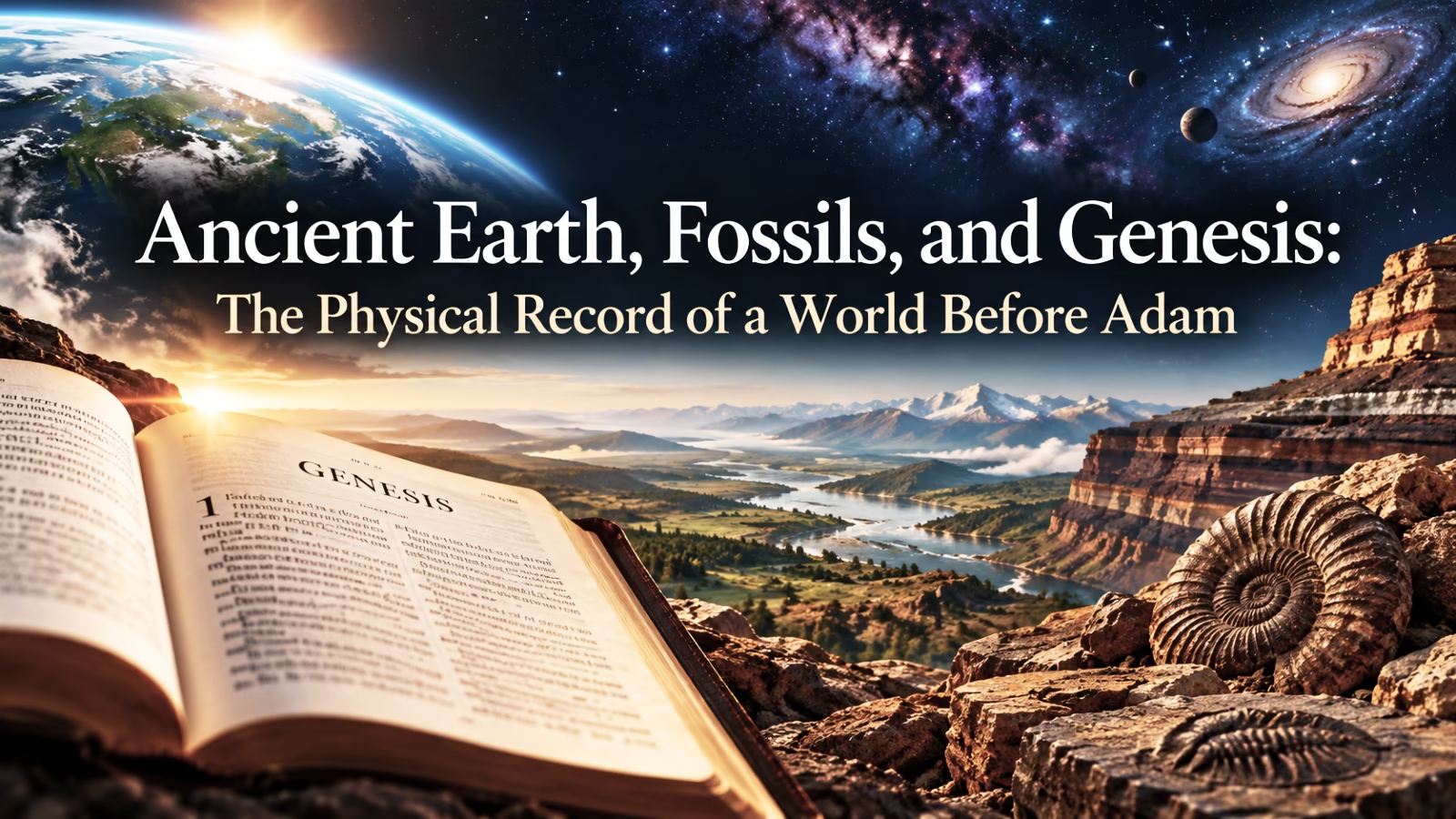
Ancient Earth, Fossils, and Genesis: The Physical Record of a World Before Adam
For many Christians, the age of the universe appears to create an unavoidable conflict between Scripture and science. Astronomy describes a universe billions of years old, geology reveals an ancient Earth, and fossils preserve a history of life extending far beyond the roughly six-thousand-year chronology associated with Adam.
But those discoveries do not break Genesis. Properly understood, they reveal the immense physical history contained behind the Bible's opening words:
“In the beginning God created the heavens and the earth.”
— Genesis 1:1, ASV
Genesis does not begin with the six days.
It begins with a creation that already existed before the condition described in Genesis 1:2.
Genesis 1:1 Contains an Earlier Created History
Genesis 1:1 gives no date for “the beginning.” It does not tell us how long the heavens and the earth existed before the scene changes in the following verse.
Genesis 1:2 presents an earth already in existence:
“And the earth was waste and void; and darkness was upon the face of the deep: and the Spirit of God moved upon the face of the waters.”
— Genesis 1:2, ASV
The earth is there, but something is profoundly wrong. It is waste and void, submerged beneath the deep, and covered by darkness.
Then God acts:
“And God said, Let there be light: and there was light.”
— Genesis 1:3, ASV
The sequence is significant:
- God created the heavens and the earth.
- The earth is later seen waste, void, submerged, and dark.
- The Spirit of God moves upon that condition.
- God speaks.
- Light appears.
- Order and life are restored.
The complete biblical explanation for the rebellion and judgment behind Genesis 1:2 belongs to another discussion. But for the question of ancient Earth and fossils, one point is decisive: the six-day work does not mark the beginning of all physical history.
Job Confirms a World Before Adam
Job takes us back to the laying of Earth's foundations.
God asks:
“Where wast thou when I laid the foundations of the earth?
— Job 38:4, ASV
Declare, if thou hast understanding.”
Then He describes who was already there:
“When the morning stars sang together,
— Job 38:7, ASV
And all the sons of God shouted for joy?”
Created beings already existed when Earth's foundations were laid. Adam did not.
Their response was also not terror, darkness, or confusion. They shouted for joy.
Job therefore confirms an ordered created history before mankind. Genesis 1:1 is not an empty heading followed immediately by the creation of everything else during the six days.
Isaiah strengthens the distinction.
“For thus saith Jehovah that created the heavens, the God that formed the earth and made it, that established it and created it not a waste, that formed it to be inhabited: I am Jehovah; and there is none else.”
— Isaiah 45:18, ASV
The word translated “waste” is the Hebrew tohu, the same word used in Genesis 1:2.
God says He did not create the earth tohu. Genesis 1:2 says the earth was tohu.
The original creation and the condition of Genesis 1:2 are not the same condition.
Science Shows Us the Physical Scale of That Earlier History
Modern astronomy places the age of the universe at approximately 13.8 billion years. NASA continues to use that figure in describing the measured age of the cosmos.
Geological and radiometric evidence places the age of Earth at approximately 4.54 billion years. The U.S. Geological Survey explains that this figure is supported by isotopic evidence from Earth materials and meteorites associated with the formation of the solar system.
Those measurements do more than merely fail to contradict Genesis.
They reveal the physical scale of the earlier created history Genesis 1:1 leaves before us without attempting to date it.
The universe is ancient.
Earth is ancient.
The rocks are ancient.
And the fossil record is ancient.
None of this requires us to force billions of years into the six days, because Scripture never placed the beginning of physical history there.
The Ancient Fossil Record Belongs to a World Before Adam
This is where the fossil record becomes especially important.
Science dates enormous numbers of fossils tens of thousands, hundreds of thousands, and millions of years before the roughly six-thousand-year Adamic chronology. Those remains testify physically that life existed on Earth long before Adam appears in the biblical record.
This is not a problem Genesis needs to escape.
It is exactly what we should expect if Genesis 1:1 contains a created history preceding the judgment of Genesis 1:2 and the recovery that follows.
The rocks preserve evidence of:
- vanished ecosystems;
- extinct animals;
- ancient seas and changing continents;
- repeated periods of biological life;
- human-like creatures;
- toolmaking;
- hunting and food preparation;
- and increasingly complex behavior.
Science cannot tell us the spiritual history of that world. But it can tell us with considerable force that the physical world did not begin six thousand years ago.
That is an important distinction.
Ancient Intelligence Is Also Preserved in the Record
The evidence is not limited to animals and plants.
The Smithsonian reports stone-tool traditions extending back millions of years. Early toolmakers deliberately struck stone to produce cutting edges, and later populations developed handaxes, projectile points, scrapers, and other specialized technologies.
Some archaeological evidence now places Oldowan stone tools around three million years ago, while other evidence indicates still earlier episodes of stone-tool production.
These are not merely bones lying in the ground.
They are evidence of creatures capable of purposeful action, tool manufacture, adaptation, and learned behavior.
Later remains reveal increasingly complex activity. Smithsonian research describes ancient populations using specialized tools, pigments, non-local materials, and exchange networks hundreds of thousands of years ago.
The physical evidence therefore establishes something important:
intelligent, human-like life existed on Earth long before the Adamic chronology.
That does not disprove Genesis.
Within the biblical sequence, it belongs to the earlier physical history Genesis already gives us room to expect.
Then Genesis Says Something Completely New
When God begins the six-day recovery, Genesis repeatedly describes living things appearing “after their kind.”
On the sixth day:
“And God said, Let the earth bring forth living creatures after their kind, cattle, and creeping things, and beasts of the earth after their kind: and it was so.”
— Genesis 1:24, ASV
Then:
“And God made the beasts of the earth after their kind, and the cattle after their kind, and everything that creepeth upon the ground after its kind: and God saw that it was good.”
— Genesis 1:25, ASV
This same pattern appears throughout the chapter with vegetation, sea creatures, birds, and land animals.
They appear according to established kinds.
Within the recovery framework, God is bringing forth created orders that already existed before the judgment of Genesis 1:2.
Then the language changes.
Man Is Not Brought Forth “After His Kind”
God does not say:
Let the earth bring forth man after his kind.
Instead:
“And God said, Let us make man in our image, after our likeness: and let them have dominion over the fish of the sea, and over the birds of the heavens, and over the cattle, and over all the earth, and over every creeping thing that creepeth upon the earth.”
— Genesis 1:26, ASV
Everything else appears according to its kind.
Man appears according to God.
That is the great transition in Genesis 1.
The created kinds represent recovery. Man represents something genuinely new.
“And God created man in his own image, in the image of God created he him; male and female created he them.”
— Genesis 1:27, ASV
The biblical definition of man is therefore not merely upright posture, a large brain, toolmaking ability, or anatomical similarity to us.
It is image, likeness, and dominion.
What, Then, Are the Ancient Human-Like Fossils?
Modern paleoanthropology classifies fossils as Homo sapiens extending back approximately 300,000 years, while other human-like populations extend much farther into the physical record.
That evidence should not be denied.
But the scientific word human and the biblical category man in God's image are answering different questions.
A fossil can reveal anatomy.
A tool can demonstrate intelligence.
DNA can demonstrate biological relationships.
Archaeology can reveal hunting, craftsmanship, exchange, social organization, and adaptation.
But none of those things can tell us that God said concerning the creature:
“Let us make man in our image.”
No skull measurement can detect God's image.
No genetic analysis can identify divine likeness.
No archaeological layer can excavate the commission:
“let them have dominion.”
Ancient Human-Like Life Is Evidence for the Earlier World, Not Against Genesis
This is where the physical evidence becomes especially valuable.
If remains classified as human or human-like are dated tens of thousands, hundreds of thousands, or millions of years before Adam, we do not need to move Adam backward until Genesis loses its own chronology.
Those remains belong to the earlier physical world.
Their intelligence does not make them the image-bearing man of Genesis 1:26 any more than anatomical resemblance alone can establish divine commission.
The fossil record therefore gives us physical evidence of something Scripture already permits: life—and even intelligent life—before the unique creation of man in God's image.
That is not a retreat from science.
It is taking both Scripture and the physical evidence seriously.
Science Cannot Tell Us What Happened Spiritually
Science can measure ancient things.
It can examine rocks, isotopes, fossils, artifacts, sediments, genetics, and astronomical light.
But its methods have limits.
Science cannot:
- place Lucifer's rebellion under a microscope;
- measure divine judgment with a radiometric clock;
- determine God's governmental purpose from a fossil;
- identify the image of God from skeletal morphology;
- or tell us why the Spirit of God moved upon the waters in Genesis 1:2.
These are not scientific failures.
They are questions outside the reach of physical measurement.
Science reveals the physical history.
Scripture reveals the spiritual and governmental meaning of that history.
Creation Can Suffer Without Being the Rebel
The ancient record contains extinction, catastrophe, disappearance, and upheaval. But those facts do not mean every living creature within the judged order was morally responsible for what happened.
Paul gives us an important principle:
“For the creation was subjected to vanity, not of its own will, but by reason of him who subjected it, in hope that the creation itself also shall be delivered from the bondage of corruption into the liberty of the glory of the children of God.”
— Romans 8:20–21, ASV
Creation can suffer “not of its own will.”
The effects of rebellion can engulf a created realm without making every creature within that realm a rebel.
This is also why the recovery of the created kinds makes sense.
They were not God's enemy.
Why “Gap Theory” Is an Inadequate Name
This biblical picture is often reduced to the term “gap theory.”
That name makes it sound as though someone discovered millions of years in geology and then inserted a convenient gap between Genesis 1:1 and 1:2 to rescue Scripture.
That is backwards.
The argument begins in the Bible:
- Genesis 1:1 presents the creation of the heavens and earth.
- Job reveals a created order already present when Earth's foundations were laid.
- Those beings respond with joy.
- Isaiah says God did not create the earth tohu.
- Genesis 1:2 presents the earth as tohu, dark, and beneath the deep.
- The Spirit of God moves upon that judged creation.
- Light and order return.
- Established kinds are brought forth again.
- Then man appears—not after an earthly kind, but in God's image and with dominion.
Science did not create that sequence.
Science gives us physical evidence of the enormous age and complexity of the world that existed before Adam.
Scripture Does Not Need Protection From the Evidence
Jesus said:
“If he called them gods, unto whom the word of God came (and the scripture cannot be broken),”
— John 10:35, ASV
If Scripture cannot be broken, we do not protect it by denying evidence God has allowed us to discover in His creation.
We do not need to pretend the universe is young when Scripture never says it is.
We do not need to erase ancient fossils.
We do not need to deny intelligent activity millions of years before Adam.
We need only allow Genesis to say what it actually says.
The Six Days Are Moving Toward Man—and Man Is Moving Toward Christ
The six-day recovery does not culminate in rocks, plants, animals, or even biological intelligence.
It culminates in image-bearing man.
That distinction becomes even more significant when the rest of Scripture reveals what God would eventually do through humanity.
Hebrews says of Christ:
“Since then the children are sharers in flesh and blood, he also himself in like manner partook of the same; that through death he might bring to nought him that had the power of death, that is, the devil;”
— Hebrews 2:14, ASV
The Son of God entered the humanity introduced in Genesis.
God's answer to the enemy would not remain outside creation.
He would enter it as Man.
This is why Genesis 1:26 is more than the appearance of another intelligent creature.
It introduces the creature through whom the Son of God could become the Son of Man.
The Beginning and the End Meet in Christ
Paul gives us the widest view of the creation:
“for in him were all things created, in the heavens and upon the earth, things visible and things invisible, whether thrones or dominions or principalities or powers; all things have been created through him, and unto him;”
— Colossians 1:16, ASV
Creation is not ultimately about its own age.
It is through Christ and unto Christ.
And after rebellion, judgment, recovery, the creation of man, mankind's fall, the incarnation, and the cross, Paul points again to Christ:
“and through him to reconcile all things unto himself, having made peace through the blood of his cross; through him, I say, whether things upon the earth, or things in the heavens.”
— Colossians 1:20, ASV
The One through whom all things came is the One through whom all things are finally brought into God's order.
That is the frame large enough to contain the whole story.
The Rocks Are Not the Enemy of Genesis
The opening sentence of Scripture is larger than we often realize:
“In the beginning God created the heavens and the earth.”
Behind that one sentence can stand billions of years of physical history.
Ancient stars.
Ancient Earth.
Vanished ecosystems.
Extinct creatures.
Human-like beings.
Toolmakers.
Intelligent activity long before Adam.
Then Scripture shows us something science could never discover from a fossil.
The earth lies waste and void beneath darkness and the deep.
The Spirit of God moves.
God speaks.
Light enters the darkness.
Order returns.
Established kinds again fill the earth.
And at the climax God does something that distinguishes this recovered world from what came before:
“Let us make man in our image.”
That man receives dominion.
Into that humanity Christ eventually comes.
Through that humanity the Son confronts the enemy, passes through death, and accomplishes the reconciliation of all things through His cross.
The ancient universe does not weaken that revelation.
The ancient Earth strengthens our recognition of how much history stands behind Genesis 1:1.
The fossil record does not overthrow the biblical account. It physically witnesses to a world far older than Adam.
And the ancient evidence of intelligent life does not erase the uniqueness of Genesis 1:26. It makes the distinction even sharper.
There were creatures before Adam. There was intelligence before Adam. There was an ancient created world before Adam.
But Genesis presents something new when God says:
“Let us make man in our image.”
Science can uncover the ancient world.
Only Scripture can tell us why image-bearing man was created.
And only the whole biblical revelation shows us where that purpose finally leads:
to Christ, through Christ, and unto Christ.