

In This Article
Recommended Books
The Seven Horns and Seven Eyes: The Spirit’s Movement from Genesis to Revelation
Why does the victorious Lamb appear in Revelation 5 with seven horns and seven eyes? These extraordinary features are central to understanding who stands before God's throne, why He alone is worthy to take the scroll, and what His victory has accomplished.
The answer begins long before John receives his vision. From the opening chapter of Genesis, Scripture reveals the Spirit of God moving to accomplish His purpose, a movement that continues through the prophets and reaches its decisive fulfillment in Jesus Christ.
When these passages are brought together, the seven horns and seven eyes become a remarkable testimony to the Lamb's completed victory and His absolute devotion to the Father's eternal purpose.
The Spirit of God Was Moving from the Beginning
The first explicit mention of the Spirit in Scripture occurs at a significant moment. Genesis describes the earth as waste and void, covered in darkness, yet the Spirit of God is already moving.
“And the earth was waste and void; and darkness was upon the face of the deep: and the Spirit of God moved upon the face of the waters.”
— Genesis 1:2 (ASV)
Before God commands light to appear, Scripture establishes the Spirit's presence and movement. The darkness and disorder do not prevent God's activity, nor do they place His purpose beyond fulfillment.
The Spirit is introduced in connection with God's work in creation. What follows is the bringing forth of light, order, life, and ultimately mankind, whom God creates in His image and likeness.
This opening establishes an important principle: God's purpose is not merely declared; it is actively carried forward. The Spirit's movement belongs to that divine activity from the beginning.
But Genesis is only the beginning of what Scripture reveals.
Ezekiel's Wheels: The Eyes and Movement of God's Throne
Centuries later, the prophet Ezekiel receives an extraordinary vision of God's glory. He sees living creatures accompanied by wheels, and the wheels possess a remarkable feature.
“As for their rims, they were high and dreadful; and they four had their rims full of eyes round about.”
— Ezekiel 1:18 (ASV)
Why would wheels be filled with eyes?
Ordinary wheels move without seeing, while ordinary eyes see without moving. In Ezekiel's vision, however, sight and movement are brought together within the administration of God's throne.
The relationship becomes clearer as Ezekiel describes their activity.
“Whithersoever the spirit was to go, they went; thither was the spirit to go: and the wheels were lifted up beside them; for the spirit of the living creature was in the wheels.”
— Ezekiel 1:20 (ASV)
The wheels do not wander independently. Their movement corresponds perfectly with the spirit directing the living creatures, while above them Ezekiel sees the likeness of a throne and the appearance of God's glory.
The vision joins spiritual direction, sight, and movement in one coordinated picture. God's throne is not presented as detached from what happens on earth; His government is active and purposeful.
Ezekiel 10 returns to the same imagery. Again, the cherubim and wheels are filled with eyes, and the glory of Jehovah moves in connection with them.
This movement includes divine judgment, demonstrating that God's activity is not confined to producing life and blessing. His purpose also requires dealing with whatever opposes His righteousness and holiness.
The eyes therefore belong to a larger revelation of God's discerning, directed activity. That connection becomes even clearer in the visions given to Zechariah.
Zechariah's Seven Eyes: The Spirit Accomplishing God's Purpose
Zechariah receives a vision involving Joshua the high priest, Satan standing as his adversary, and the removal of Joshua's filthy garments. God then announces the coming of His servant, the Branch, and introduces a stone bearing seven eyes.
“For, behold, the stone that I have set before Joshua; upon one stone are seven eyes: behold, I will engrave the graving thereof, saith Jehovah of hosts, and I will remove the iniquity of that land in one day.”
— Zechariah 3:9 (ASV)
The seven eyes appear in a remarkable setting. The vision concerns the removal of iniquity, the restoration of priestly service, and God's promise of a decisive work that will accomplish what the existing condition cannot.
The connection between the eyes and God's purpose becomes more explicit in the following chapter.
Not by Might, but by My Spirit
In Zechariah 4, the prophet sees a golden lampstand with seven lamps and two olive trees. The vision concerns the completion of God's house under Zerubbabel, but the Lord identifies the power by which that work will be accomplished.
“Not by might, nor by power, but by my Spirit, saith Jehovah of hosts.”
— Zechariah 4:6 (ASV)
The completion of God's house does not depend upon human strength. The Spirit of God is the governing power by which His purpose advances despite opposition and apparent weakness.
A few verses later, the seven eyes appear again.
“For who hath despised the day of small things? for these seven shall rejoice, and shall see the plummet in the hand of Zerubbabel; these are the eyes of Jehovah, which run to and fro through the whole earth.”
— Zechariah 4:10 (ASV)
Here, the seven eyes are expressly identified as the eyes of Jehovah, ranging throughout the earth. They appear in the very passage declaring that God's Spirit will accomplish the building of His house.
Consider the progression now visible in Scripture:
- Genesis: The Spirit moves as God brings forth His creation.
- Ezekiel: Eyes and Spirit-directed movement appear together in the vision of God's throne.
- Zechariah 3: Seven eyes appear in connection with the removal of iniquity.
- Zechariah 4: The seven eyes range throughout the earth as God declares that His Spirit will accomplish the building of His house.
These are not disconnected images. Together they reveal God's purposeful activity: discerning, moving, removing what opposes Him, and bringing His intended work to completion.
And the next great movement of the Spirit brings us to Jesus Christ.
The Spirit Enters the Story of Christ's Human Life
When the angel Gabriel announces the birth of Jesus to Mary, he explains how the Son of God will enter human life.
“The Holy Spirit shall come upon thee, and the power of the Most High shall overshadow thee: wherefore also the holy thing which is begotten shall be called the Son of God.”
— Luke 1:35 (ASV)
The Spirit who moved in Genesis is now involved in the incarnation of the Son of God. The eternal Word enters humanity, not as an ordinary descendant of fallen Adam, but through the direct operation of God's Spirit.
Jesus later declares that God is Spirit (John 4:24). His earthly life would demonstrate what a genuine human life looks like when lived in perfect obedience to the Father through the Spirit.
At His baptism, the Holy Spirit descends upon Him in bodily form as a dove (Luke 3:22). Jesus then enters the wilderness full of the Holy Spirit, where He confronts Satan and refuses every temptation to act independently of the Father.
This perfect obedience continues throughout His ministry. He teaches, heals, and casts out demons, explicitly attributing His victory over evil spirits to the Spirit of God (Matthew 12:28).
A Life Entirely Devoted to the Father's Purpose
Jesus explains the governing principle of His earthly life with extraordinary simplicity.
“My meat is to do the will of him that sent me, and to accomplish his work.”
— John 4:34 (ASV)
His purpose was not to establish an independent kingdom or pursue His own will. Everything He accomplished was directed toward fulfilling the Father's eternal purpose.
Here the earlier visions acquire deeper significance. God's purposeful movement, previously revealed through wheels and seven eyes, is now demonstrated in the actual human life of His Son.
Christ did not merely possess knowledge of the Father's purpose. He devoted His entire life to carrying it out.
That devotion reached its highest expression at Calvary.
“How much more shall the blood of Christ, who through the eternal Spirit offered himself without blemish unto God, cleanse your conscience from dead works to serve the living God?”
— Hebrews 9:14 (ASV)
Christ's obedience and the Spirit's operation were not separated at the Cross. The Son offered Himself willingly, through the eternal Spirit, in complete faithfulness to the Father.
The Spirit's movement throughout Scripture has now reached something unprecedented: the perfect sacrifice of the sinless Son, accomplishing a victory that no other human being could achieve.
And that brings us directly to Revelation 5.
The Victorious Lamb Appears Before God's Throne
John sees a book sealed with seven seals in the right hand of the One sitting upon the throne. A mighty angel asks who is worthy to open it, but no one in heaven, on earth, or under the earth is found qualified.
John begins to weep.
The question is not whether someone possesses sufficient physical power to break the seals. The question is worthiness, and the entire search reveals that no one within the existing order has accomplished what is required.
Then one of the elders announces that the Lion of the tribe of Judah, the Root of David, has overcome.
But when John looks, he does not see a lion displaying ordinary earthly power. He sees a Lamb standing as though slain, possessing seven horns and seven eyes.
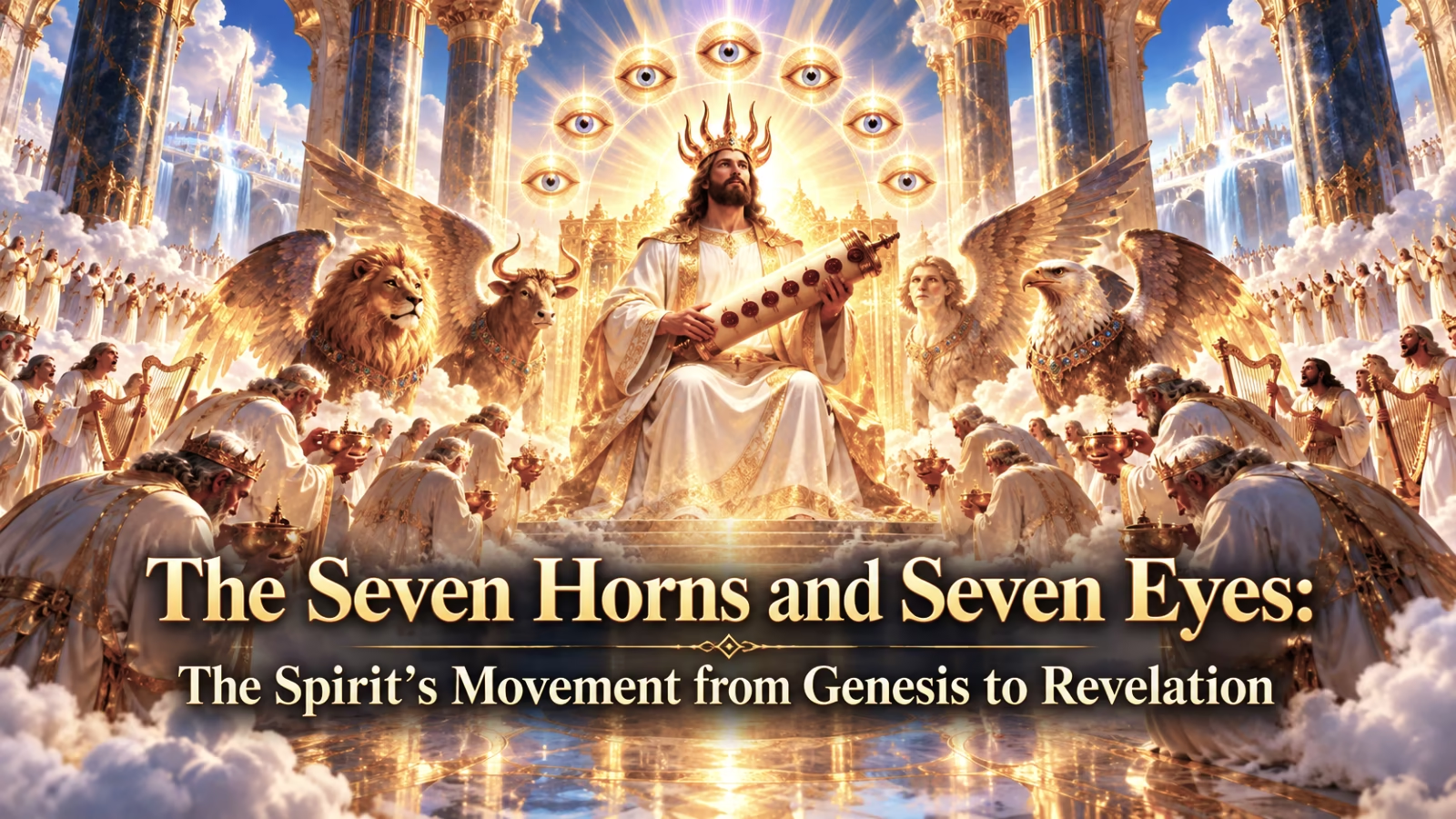
“And I saw in the midst of the throne and of the four living creatures, and in the midst of the elders, a Lamb standing, as though it had been slain, having seven horns, and seven eyes, which are the seven Spirits of God, sent forth into all the earth.”
— Revelation 5:6 (ASV)
This is the heart of the revelation.
The Lamb is standing in victory, bearing the evidence of His sacrifice, possessing seven horns and seven eyes. These are not incidental decorations, but essential features of how heaven presents the One worthy to take the scroll.
The Seven Horns: The Fullness of His Victorious Power
Throughout Scripture, horns represent strength, power, and authority. God is described as the horn of salvation, and Luke 1:69 identifies Christ with the horn of salvation raised up in David's house.
The sacrificial system also gives horns an important place. The altar of burnt offering had four horns (Exodus 27:2), and the blood of sin offerings was applied to altar horns as part of the appointed sacrificial service (Leviticus 4).
Yet those sacrifices could never accomplish the eternal removal of sin. Hebrews 10 explains that the repeated offerings were shadows pointing toward the single, sufficient offering of Jesus Christ.
The Lamb in Revelation 5 bears seven horns.
Seven repeatedly signifies fullness and completion in Revelation, and the horns upon the slain Lamb reveal the fullness of the victorious power belonging to Him. What the earlier sacrificial order could only anticipate, Christ has accomplished through His own blood.
His sacrifice is not awaiting some future improvement. His obedience is complete, His offering is sufficient, and His victory has established the foundation for the fulfillment of God's eternal purpose.
The seven horns testify to the complete victorious authority of the resurrected Christ, the Firstborn from the dead and the beginning of God's new creation (Colossians 1:18).
The Seven Eyes: The Fullness of the Spirit and the Father's Purpose
Now consider the seven eyes.
Revelation itself identifies them as the seven Spirits of God sent forth into all the earth. This description must be understood alongside the one Spirit revealed throughout Scripture (Ephesians 4:4), whose fullness is represented in the sevenfold imagery.
In Ezekiel, eyes accompanied movement directed by the spirit. In Zechariah, seven eyes ranged throughout the earth in connection with the Spirit's work of removing iniquity and completing God's house.
In Revelation 5, those seven eyes belong to the Lamb Himself.
What an extraordinary testimony to the life He has just completed.
The Spirit who brought Him into humanity, descended upon Him at His baptism, empowered His ministry, and was involved in His offering to God is represented in fullness upon the victorious Lamb.
The eyes testify to more than perfect sight. Brought together with the earlier visions, they reveal the completeness of God's purposeful movement in the One who faithfully accomplished the Father's will.
The seven horns display the fullness of His victorious power. The seven eyes reveal the fullness of the Spirit associated with that victory, the divine activity through which His earthly obedience and sacrifice were accomplished.
The Lamb stands before the throne as the perfect fulfillment of the Father's purpose, with nothing lacking in His obedience, sacrifice, or victory.
He alone is worthy.
The Scroll Is Taken, and Heaven Sings a New Song
Revelation 5:7 records the decisive action. The Lamb comes and takes the book from the right hand of Him who sits upon the throne.
The search is over, and John's weeping gives way to worship.
The living creatures and twenty-four elders fall before the Lamb, holding harps and golden bowls containing the prayers of the saints. Then heaven sings a new song.
“Worthy art thou to take the book, and to open the seals thereof: for thou wast slain, and didst purchase unto God with thy blood men of every tribe, and tongue, and people, and nation.”
— Revelation 5:9 (ASV)
Notice why the song is sung. The Lamb is worthy because He was slain and redeemed people for God through His blood.
This is a song celebrating an accomplished work, not an anticipated victory whose outcome remains uncertain. The resurrection has already inaugurated the new creation in Christ, and heaven now celebrates the victorious One through whom God's eternal purpose will be brought to completion.
The song also declares that the redeemed have been made a kingdom and priests unto God, destined to reign upon the earth (Revelation 5:10). God's purpose has always extended beyond the defeat of His enemies to the obtaining of a people who share His life, serve in His presence, and express His government.
The celebration grows until John hears innumerable angels proclaiming the worthiness of the slain Lamb. Then every created thing joins in blessing, honor, glory, and dominion to the One upon the throne and to the Lamb (Revelation 5:11–14).
Jesus had already declared that He overcame and sat down with His Father on His throne (Revelation 3:21). Revelation 5 now displays the victorious Lamb receiving the worship that belongs to His completed redemption and royal authority.
The King has overcome, the scroll is in His hand, and heaven celebrates the victory upon which the new creation rests.
But the purpose represented by the scroll must still be carried into its complete fulfillment.
The Spirit Goes Forth to Continue the King's Conquest
Before His death, Jesus told the disciples that His departure was necessary for the coming of the Helper. He promised to send the Holy Spirit, who would convict the world, glorify Christ, and take what belonged to Him and declare it to His people (John 16:7–15).
That promise concerns the continuation of Christ's accomplished work. The Spirit would not come to win a victory that Jesus had failed to achieve, but to bring the life and power of that victory into humanity.
The Cross had defeated and disarmed the hostile powers, yet their influence and the effects of sin remained operative within the fallen world. The saints still required transformation, and the spiritual strongholds resisting God's purpose still had to be overcome.
The Spirit's work was therefore essential to the completion of God's eternal habitation. Through the law of the Spirit of life, believers are freed from the law of sin and death, put to death the deeds of the body, and are transformed into the image of Christ (Romans 8:2, 13; 2 Corinthians 3:18).
Now return to the heavenly throne.
The Lamb possesses the seven horns and seven eyes. He has taken the scroll, heaven has celebrated His victory, and the enthroned King is fully qualified to administer everything necessary for God's eternal purpose.
Then the Lamb opens the first seal.
“And I saw, and behold, a white horse, and he that sat thereon had a bow; and there was given unto him a crown: and he came forth conquering, and to conquer.”
— Revelation 6:2 (ASV)
The Spirit who moved upon the waters in Genesis, whose purposeful activity appeared in Ezekiel's wheels and Zechariah's seven eyes, who brought Christ into human life and participated in His perfect obedience and sacrifice, now goes forth as the crowned conqueror.
The decisive victory belongs to Christ, who has overcome and taken His seat with the Father. The Holy Spirit carries that victory forward, confronting the defeated spiritual powers, overcoming their influence within humanity, and bringing the King's accomplished work into His people.
From the Spirit's first movement in Genesis to the seven eyes of the victorious Lamb in Revelation 5, Scripture reveals one continuous divine purpose. The crowned white-horse rider now goes forth, conquering and continuing the conquest of the victorious King.