

In This Article
Recommended Books
The Biblical Case for More Than Eight People on Noah’s Ark
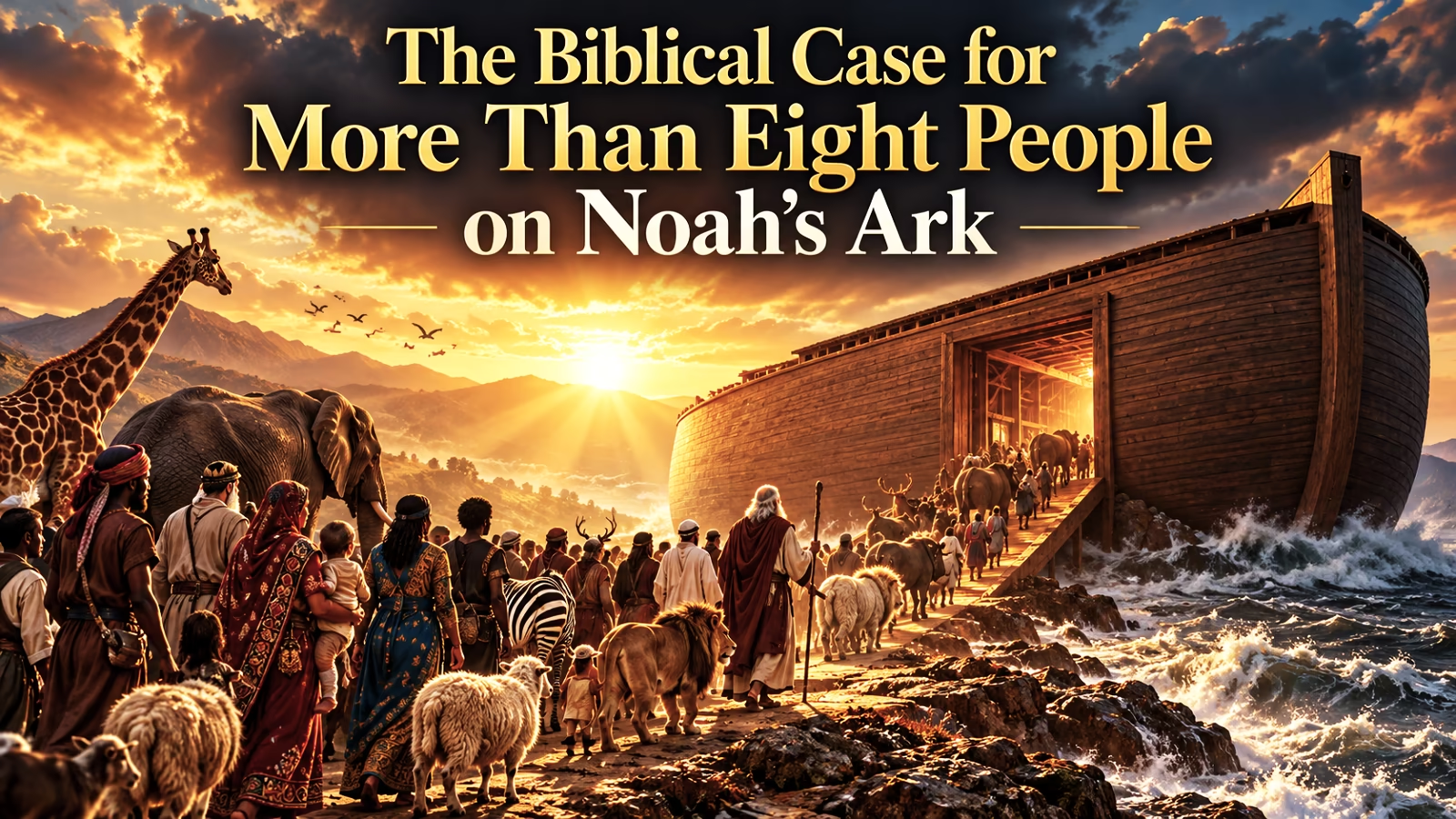
Most Christians have been taught that only eight human beings survived Noah's Flood: Noah, his wife, his three sons, and their wives. Scripture unquestionably identifies those eight people, and both Genesis and Peter give them particular attention.
But identifying eight people is not necessarily the same as establishing that no other human beings were aboard the Ark. That distinction becomes significant when we examine the Flood within the entire biblical revelation, beginning with God's original creation and ending with the nations in New Jerusalem.
Genesis introduces Adam, the first man, and then records the creation of male and female humanity on Day Six. The account identifies them as belonging to the same human kind, but it does not describe the Day Six population as being biologically produced from Adam's reproductive seed.
God blessed that humanity, commissioned them to fill the earth, and declared His completed creation very good.
The Flood then brings judgment upon living flesh while the Ark preserves God's created order through that judgment. Yet the usual eight-person interpretation leaves a serious question unanswered:
What happened to the independently created male and female humanity of Day Six?
If Noah's three sons were the only surviving human males, their descendants would continue Adam's paternal bloodline. They could not reproduce an independently created Day Six paternal lineage that had completely disappeared.
That raises a question far more consequential than the number of passengers aboard the Ark.
Did God preserve the human creation He had called very good, or did He permanently eliminate part of that creation and replace its biological population with descendants of another line?
The answer must agree with Scripture from beginning to end, particularly Christ's final declaration:
"And he that sitteth on the throne said, Behold, I make all things new."
Revelation 21:5 (ASV)
God's Creation Is Traced From Beginning to Completion
The Bible is the revelation of Jesus Christ, but its testimony does not concern the promised King apart from the creation He came to redeem. Scripture follows the King toward His Kingdom while also revealing the origin, corruption, preservation, judgment, and ultimate restoration of God's creation.
Genesis introduces the heavens and earth, living creatures, humanity, Paradise, and the Tree of Life. Revelation returns to the heavens and earth, God's dwelling, the Tree of Life, and the nations living under the government of God and the Lamb.
These are not unrelated accounts.
The entire biblical revelation moves toward the completion of God's purpose in Christ. What begins in Genesis finds its ultimate meaning and fulfillment in Him.
Creation Is Not Merely the Background of Redemption
God did not create a disposable world that would become irrelevant once Christ accomplished redemption. Paul describes creation itself as awaiting deliverance.
"that the creation itself also shall be delivered from the bondage of corruption into the liberty of the glory of the children of God."
Romans 8:21 (ASV)
Notice that Paul speaks of creation itself being delivered. His argument spans Romans 8:18–23, where creation awaits the revealing of the sons of God, groans under corruption, and looks toward deliverance.
Then Paul makes the scope of that creation unmistakable:
"For we know that the whole creation groaneth and travaileth in pain together until now."
Romans 8:22 (ASV)
The whole creation. Not all creation except the male and female humanity of Day Six.
What is included in the whole creation? Genesis 1 identifies what God created, including the male and female humanity of Day Six, whom He blessed and included in the creation He pronounced very good.
Paul does not promise that every individual creature escapes death, and the Flood certainly did not preserve every individual. The Ark preserved living representatives so that God's created order could continue through judgment.
But if the independently created Day Six human population was completely extinguished, Noah's descendants could populate the earth without restoring its lost biological lines. Continuing the human kind would not be the same as preserving that distinct part of God's original human creation.
In verse 23, Paul connects creation's groaning with the believers' expectation of bodily redemption. His vision is deliverance from corruption, not the silent disappearance of part of God's original work.
He does not describe redemption as God abandoning His corrupted creation and substituting an unrelated one. The creation subjected to corruption is the creation awaiting deliverance.
If Day Six humanity was lost as an independently created population, how does that permanent loss fit Paul's declaration concerning the whole creation? The eight-only interpretation must answer that question rather than treating biological substitution as preservation.
Peter likewise speaks of Christ remaining in heaven until the appointed restoration.
"whom the heaven must receive until the times of restoration of all things, whereof God spake by the mouth of his holy prophets that have been from of old."
Acts 3:21 (ASV)
This restoration fulfills what God announced through the prophets. It does not mean that every original physical condition must remain unchanged, but it establishes that God's final purpose concerns the recovery and completion of His creation.
That principle must inform our understanding of the Flood.
The Ark stands between the original creation and its final restoration. It is the vessel through which God preserves living creation beyond the judgment of the old world.
Before deciding who entered the Ark, we must therefore examine what God originally created.
Adam Was the First Man of the Human Kind
Genesis 2 records Adam's distinctive formation.
"And Jehovah God formed man of the dust of the ground, and breathed into his nostrils the breath of life; and man became a living soul."
Genesis 2:7 (ASV)
Adam was formed directly by God, received the breath of life, and was placed within the Garden of Eden. His formation belongs to a particular sequence described in Genesis 2.
The Chronology of Adam's Formation
Genesis 2 begins the account of Adam's formation by describing conditions that existed before certain vegetation had appeared.
"And no plant of the field was yet in the earth, and no herb of the field had yet sprung up; for Jehovah God had not caused it to rain upon the earth: and there was not a man to till the ground;"
Genesis 2:5 (ASV)
The narrative continues by describing the watering of the ground and God's formation of Adam from its dust (Genesis 2:6–7). Genesis 1 records the appearance of vegetation on Day Three.
"And God said, Let the earth put forth grass, herbs yielding seed, and fruit-trees bearing fruit after their kind, wherein is the seed thereof, upon the earth: and it was so."
Genesis 1:11 (ASV)
The chronological relationship matters.
Genesis 2:5 describes the absence of plants and herbs of the field, whereas Genesis 1:11 describes the broader vegetation brought forth on Day Three. The reference to the field, rain, and a man to till the ground must be examined rather than simply assuming both accounts describe identical categories of vegetation.
But Genesis 2 does more than describe an environmental condition.
It gives a connected sequence of events surrounding Adam's creation:
- God forms Adam from the dust of the ground (Genesis 2:7).
- God plants the Garden of Eden and places Adam within it (Genesis 2:8).
- God gives Adam responsibility for the Garden (Genesis 2:15).
- God brings the living creatures to Adam for naming (Genesis 2:19–20).
- God forms Eve from Adam after no corresponding helper is found (Genesis 2:21–22).
Genesis 1 then records God's creation of male and female humanity on Day Six, followed by His blessing and command that they multiply. Reading these passages together, Adam's earlier formation and Eve's direct formation from him belong to a distinct creative sequence from the Day Six account.
The distinction is not based solely upon the meaning of the plants of the field. It also rests upon the different sequences, methods of creation, and commissions recorded in the two accounts.
Genesis 2 specifically explains the physical origin of Adam and Eve. Genesis 1:27 describes God creating male and female humanity without stating that this creation was accomplished through the reproductive seed of Adam.
And Genesis 1:28 places the command to reproduce after God's creation of male and female. That order must be respected.
Human reproduction cannot be substituted for God's act of creation merely because the resulting human beings belong to the same kind.
Genesis 1 treats Day Six as a distinct period of divine work. It was not simply a day during which Adam and Eve fulfilled an earlier command to reproduce.
The formation of Adam, the formation of Eve, and the creation of male and female humanity on Day Six must be examined according to what Scripture actually records, not collapsed into one biological event without explanation.
Eve Was Formed Directly From Adam
Genesis explains exactly where Eve's flesh came from.
"And the rib, which Jehovah God had taken from the man, made he a woman, and brought her unto the man."
Genesis 2:22 (ASV)
Adam declares:
"This is now bone of my bones, and flesh of my flesh: she shall be called Woman, because she was taken out of Man."
Genesis 2:23 (ASV)
Eve's biological relationship to Adam is explicit. God formed her from Adam's own body.
That detail becomes important when we examine the Day Six creation. Scripture specifically identifies the origin of Eve's flesh, but it gives no corresponding account in which God produces the Day Six population from Adam's reproductive seed or Eve's womb.
Belonging to the same created human kind does not, by itself, establish descent from the same biological parents.
The Garden Reveals Adam's Particular Calling
Adam was placed within God's Garden and given a specific responsibility.
"And Jehovah God took the man, and put him into the garden of Eden to dress it and to keep it."
Genesis 2:15 (ASV)
The Garden was the place of God's immediate fellowship with man. It contained the Tree of Life, and Adam received responsibility for its care.
This arrangement anticipates the divine dwelling and government ultimately manifested in New Jerusalem. Adam's assignment was connected with God's dwelling and the life found in His presence.
The Garden was not the entire earth. Nor was Adam's specific assignment identical to the commission later given to humanity on Day Six.
That distinction provides an important connection between the beginning of Scripture and the nations surrounding New Jerusalem at its completion.
Day Six Was a Day of Creation, Not Reproduction
Genesis 1:27 declares:
"And God created man in his own image, in the image of God created he him; male and female created he them."
Genesis 1:27 (ASV)
This verse describes God creating humanity. It does not describe Adam and Eve producing children through sexual reproduction, nor does it identify the male and female humanity created on Day Six as children born from Eve.
The order matters.
First, God creates male and female. Then He blesses them and commands them to multiply.
"And God blessed them: and God said unto them, Be fruitful, and multiply, and replenish the earth, and subdue it; and have dominion over the fish of the sea, and over the birds of the heavens, and over every living thing that moveth upon the earth."
Genesis 1:28 (ASV)
Creation and reproduction are not interchangeable.
God's creative work establishes living creatures. His blessing gives them the capacity and commission to reproduce.
The same distinction appears earlier in the creation week. God created the living creatures of the waters and the birds of the heavens, then blessed them and commanded them to multiply (Genesis 1:20–22).
We would not interpret the creation of birds as merely the natural reproduction of birds already in existence.
Why, then, should God's creation of male and female humanity automatically be reduced to Adam and Eve producing children?
Day Six was a day of God's creative activity. It was not merely a day during which humanity performed the ordinary biological work God had already enabled it to perform.
One Human Kind Does Not Require One Biological Family
Genesis describes living creatures according to their kinds. Creatures belonging to one kind possess a common created nature, but that does not require every individual to have originated through the reproductive seed of one original pair.
Adam was the first man, establishing the human kind through God's direct formation. The Day Six account records God creating male and female humanity of that same human kind.
Their shared humanity does not require the conclusion that Adam's reproductive seed was used to create them.
Genesis 5:1–2 repeats the language of humanity created male and female before proceeding with Adam's genealogy. This shows how the same designation can refer to humanity collectively while the narrative follows a particular man and his descendants.
That distinction matters throughout Scripture.
The genealogical record concerns a specific line of descent. The term humanity can describe the created kind more broadly.
Their Commissions Were Distinct
Adam was placed in the Garden to dress and keep it. Day Six humanity was commissioned to multiply, replenish the earth, subdue it, and exercise dominion over living creatures.
These were different responsibilities within God's creation.
The Garden was a particular location associated with God's presence. The Day Six commission concerned humanity inhabiting and exercising responsibility throughout the earth.
This arrangement anticipates a distinction that becomes visible again in Revelation: God's dwelling at the center of His completed order and the nations living under His government.
Cain Encounters Humanity Beyond His Immediate Household
Genesis 4 introduces Cain after the murder of Abel. Cain fears that someone who encounters him will kill him.
"and it will come to pass, that whosoever findeth me will slay me."
Genesis 4:14 (ASV)
God responds by appointing a sign so that anyone finding Cain will not kill him. Cain subsequently leaves God's presence, settles in the land of Nod, has a wife, and establishes a city named after his son Enoch (Genesis 4:16–17).
The account raises questions that are commonly answered by assuming generations of unnamed descendants of Adam and Eve.
Genesis 5:4 does tell us that Adam fathered sons and daughters. However, Genesis 4 does not identify Cain's wife, the people he feared, or the population associated with his city as belonging to Adam's biological family.
The existence of humanity created on Day Six provides a coherent explanation for the wider population Cain encounters. Cain's account does not supply an independent census of that population, but it fits the broader distinction between Adam's traced family and humanity living beyond the Garden.
Sin Entered the Human World Through One Man
A distinction between Adam's biological family and Day Six humanity must not create two different human natures.
Paul writes:
"Therefore, as through one man sin entered into the world, and death through sin; and so death passed unto all men, for that all sinned:"
Romans 5:12 (ASV)
Paul identifies Adam as the man through whom sin and death entered the world. He does not explain that sin entered through the mechanical transmission of Adam's reproductive seed to every human being.
Adam's fall affected the human kind. This agrees with Paul's distinction between the first Adam and the Last Adam in 1 Corinthians 15:45–49.
Adam is the first man of the human kind. Christ is the Last Adam, through whom God brings forth the new creation.
Those born again in Christ belong to Him through the life of the Spirit, not because they were physically conceived through Christ's reproductive seed. The parallel helps distinguish shared human nature from biological descent without diminishing Adam's position as the first man.
Paul Says God Made Every Nation "Of One"
Acts 17:26 is particularly relevant.
"and he made of one every nation of men to dwell on all the face of the earth, having determined their appointed seasons, and the bounds of their habitation;"
Acts 17:26 (ASV)
Paul emphasizes God's sovereignty as Creator of the nations and Lord over their habitation. The ASV says "of one" without explicitly adding "man" or "blood." The Greek textual tradition contains a longer reading with "blood," so the precise wording must not be made to prove more than it establishes.
Nevertheless, Paul's statement agrees with the unity of humanity under one Creator.
Every nation belongs to God's created human kind. Nothing in Paul's argument requires the nations to exist outside God's authority or purpose.
One human kind and one Creator do not, by those descriptions alone, establish one exclusive biological ancestry.
Scripture Traces the Promised Seed Through a Particular Family
Following Adam's genealogy is not an incidental feature of Genesis. God announces a promise concerning the woman's Seed immediately after the fall.
"and I will put enmity between thee and the woman, and between thy seed and her seed: he shall bruise thy head, and thou shalt bruise his heel."
Genesis 3:15 (ASV)
The promise begins with the woman's Seed. As Scripture unfolds, God progressively identifies the family through which that promised Seed will come.
The line proceeds through:
- Adam and Seth
- Noah and Shem
- Abraham, Isaac, and Jacob
- Judah
- David
- Jesus Christ
Genesis 5 traces Adam's family to Noah because that genealogy matters to God's promise. After the Flood, Scripture continues through Noah's descendants toward Abraham and eventually David.
The royal line receives sustained attention because God is bringing His promised Son into the world through that family.
But tracing one family in detail does not establish that every other human population must descend biologically from that family.
A genealogy can be complete for its stated purpose without being an exhaustive account of every population living on earth. This is the distinction we must preserve when reading Noah's story.
The Bible follows the promised King, but it also follows God's creation toward its appointed completion.
The Flood Was a Judgment Upon Living Creation
Genesis 6 describes a world corrupted by wickedness and violence. God announces judgment upon living flesh.
"And I, behold, I do bring the flood of waters upon this earth, to destroy all flesh, wherein is the breath of life, from under heaven; everything that is in the earth shall die."
Genesis 6:17 (ASV)
The judgment concerns living flesh possessing the breath of life. Day Six humanity unquestionably belonged to that category.
They were human beings, created male and female, possessing the life God had given to the human kind. But God's announcement of judgment is immediately followed by His provision for preservation.
"And of every living thing of all flesh, two of every sort shalt thou bring into the ark, to keep them alive with thee; they shall be male and female."
Genesis 6:19 (ASV)
The purpose is explicit: "to keep them alive with thee." God is not describing resurrection thousands of years later.
He is preserving living creation through representatives so that life can continue after the judgment. The following verse specifically identifies birds, cattle, and creeping things according to their kinds.
The principle is continuity through judgment.
Preservation Does Not Require Every Individual to Survive
Many animals perished in the Flood, yet their created kinds continued through the Ark. The destruction of individual creatures did not mean the extinction of the kinds to which they belonged.
This distinction is fundamental. The Flood judged the corrupted world while God provided for the continuation of living creation.
Day Six humanity was part of that original creation.
Why should God's preservation of living creation be understood to exclude the distinct human population He created, blessed, and commissioned on Day Six?
Noah and his family could preserve the human kind. But the preservation of a human kind and the preservation of every independently created biological population within that kind are not identical propositions.
An interpretation that eliminates Day Six humanity entirely must explain that loss, not merely assume that Noah's descendants replaced them.
The Connection Between Day Six and Those Who Entered the Ark
Genesis 7 brings the preservation account to its decisive moment. First, Noah's household is identified.
Genesis 7:13 names Noah, Shem, Ham, Japheth, Noah's wife, and the wives of his sons. The following verse lists the living creatures according to their kinds.
Then Scripture states:
"And they went in unto Noah into the ark, two and two of all flesh wherein is the breath of life."
Genesis 7:15 (ASV)
And immediately afterward:
"And they that went in, went in male and female of all flesh, as God commanded him: and Jehovah shut him in."
Genesis 7:16 (ASV)
Notice the creation language repeated in these verses:
- Male and female
- All flesh
- The breath of life
- God's command
- The preservation of living creation
These expressions reach back into Genesis 1 and 2.
"Male and Female of All Flesh"
Genesis 1:27 describes God creating humanity male and female. Genesis 7:16 describes those entering the Ark as male and female of all flesh.
The immediate context of Genesis 7:14–16 concerns animals entering according to their kinds, so the expression certainly includes those animals. The change from "two and two" in verse 15 to "male and female" in verse 16 should not be treated as proof that a different category entered last.
But neither should we overlook the broader creation language.
Day Six humanity was male and female, belonged to all flesh, and possessed the breath of life.
Nothing about those descriptions places that population outside God's original living creation. The Ark account specifically identifies Noah's Adamic household while describing the wider preservation of living creatures through categories drawn from creation itself.
That makes the distinction between the named covenant household and the broader created order essential to understanding the passage.
The wording does not independently enumerate additional human passengers. Its importance is that the description of preserved life belongs to the same creation account in which Day Six humanity received its existence.
The Ark Carries Creation Through Judgment
God did not have to recreate the birds, cattle, and other living creatures after the Flood. He preserved representatives through the Ark.
Their identities as created kinds continued beyond judgment. Day Six humanity belongs to that original created order, and Scripture nowhere announces a second creation of humanity after the Flood.
The question, therefore, is not merely whether Noah's descendants could multiply. It is whether the original Day Six population was biologically preserved or whether its independent existence ended completely.
That issue cannot be resolved by counting Noah's sons alone.
Day Six Humanity Could Not Have Survived Outside a Worldwide Flood
Genesis describes the destruction of terrestrial life outside the Ark.
"And all flesh died that moved upon the earth, both birds, and cattle, and beasts, and every creeping thing that creepeth upon the earth, and every man:"
Genesis 7:21 (ASV)
The next verse adds:
"all in whose nostrils was the breath of the spirit of life, of all that was on the dry land, died."
Genesis 7:22 (ASV)
Under the worldwide Flood described in Genesis, no human population could simply have remained alive somewhere beyond the waters. Day Six humanity could not escape the judgment by living in a different geographical region.
Its living representatives would have needed to pass through the Ark.
Genesis 7:23 concludes:
"and Noah only was left, and they that were with him in the ark."
Genesis 7:23, concluding words (ASV)
The verse identifies Noah and those preserved with him.
It does not provide a separate numerical count of every human being aboard. Its wording also accommodates the animals as members of the living creation preserved with Noah.
The central fact remains: the Ark was the place where God preserved living creation through the Flood. That is where the continued existence of Day Six humanity must be accounted for.
Why Genesis Specifically Identifies Noah's Eight-Member Household
God's command to Noah identifies his immediate household.
"But I will establish my covenant with thee; and thou shalt come into the ark, thou, and thy sons, and thy wife, and thy sons' wives with thee."
Genesis 6:18 (ASV)
This statement connects God's covenant with the preservation of Noah's family. Noah belongs to Adam's genealogy through Seth.
His sons continue that line, and through their descendants the promised Seed will eventually come. The preservation of this household therefore occupies a particular place in the unfolding revelation of Christ.
Genesis has a clear reason to name these eight people.
They are the identifiable covenant household through which the promised King will come.
The living creatures receive no comparable genealogical attention. They are generally identified according to their kinds because Scripture is not tracing their reproductive histories toward the promised Seed.
That difference in narrative attention is not evidence that the other created kinds were unimportant. It reflects the particular role of the family through which Christ would enter the world.
The same distinction gives us a framework for examining Peter's references to the eight.
Peter's Eight Souls and the Preservation of the Covenant Household
Peter refers to eight preserved people in two passages. These are the strongest numerical statements used to support the conclusion that no other human beings survived the Flood.
But both passages identify precisely the household already named in Genesis, and both occur in discussions of God's judgment and deliverance.
First Peter 3:20–21: Eight Souls Saved Through Water
Peter writes:
"that aforetime were disobedient, when the longsuffering of God waited in the days of Noah, while the ark was a preparing, wherein few, that is, eight souls, were saved through water:"
1 Peter 3:20 (ASV)
Peter immediately connects that deliverance with baptism and the resurrection of Jesus Christ. He is drawing upon the preservation of Noah's household to explain salvation through Christ.
The connection to Genesis is significant.
Genesis 5 traces Adam's genealogy to Noah. Genesis 6:18 then identifies God's covenant with Noah and explicitly names the members of his household who will enter the Ark.
Peter identifies the same eight people. The covenant household preserved through the Flood is the household that carries the promised Seed forward.
Peter's eight souls are not an unexplained number. They are the eight members of the family whose preservation is central to the biblical account of God's covenant and the coming King.
That is why their deliverance is so fitting as an illustration of salvation through Christ.
Second Peter 2:5: Noah and Seven Others
Peter writes again:
"and spared not the ancient world, but preserved Noah with seven others, a preacher of righteousness, when he brought a flood upon the world of the ungodly;"
2 Peter 2:5 (ASV)
Here Peter contrasts God's judgment upon the ungodly with His preservation of the righteous. He places Noah's deliverance alongside the deliverance of Lot, then states the principle governing both examples.
"the Lord knoweth how to deliver the godly out of temptation, and to keep the unrighteous under punishment unto the day of judgment;"
2 Peter 2:9 (ASV)
Peter is using the preservation of Noah and his family to demonstrate God's faithfulness in judgment and deliverance. He is not presenting a biological history of the populations created in Genesis 1.
In both letters, Peter consistently identifies the same covenant household.
What Peter's Eight Establish—and What Remains to Be Accounted For
Peter establishes that eight souls were saved through water and that God preserved Noah with seven others. Those statements must be accepted exactly as written.
But the additional conclusion that these eight exhausted every human being aboard the Ark depends upon treating Peter's count as a complete human passenger census.
Peter does not expressly state that he is distinguishing Adamic descendants from Day Six humanity. That distinction must be established from the broader creation account and the purpose of the genealogies.
Yet Peter also does not address the fate of independently created Day Six humanity or announce its biological extinction. His subject is the preservation of the household whose covenant history leads to Christ.
The question is therefore not whether Peter correctly counted eight people. He did.
The question is whether the eight members of the covenant household were the totality of humanity preserved, or whether Scripture's wider account of creation and preservation requires us to recognize human survivors beyond that named household.
Peter's words cannot be separated from the Genesis account that gives those eight their identity and purpose. Nor should the preservation of the promised Seed be mistaken for an exhaustive account of every biological line God originally created.
Noah's Preaching and God's Patience Before the Flood
Peter calls Noah a preacher of righteousness. First Peter 3:20 also speaks of God's patience while the Ark was being prepared.
The Flood was not presented as judgment arriving without any preceding testimony of righteousness. God gave Noah His instructions, and Noah obeyed.
Genesis then records the living creatures entering the Ark under God's direction. Such an event would have provided extraordinary evidence of divine involvement to anyone who witnessed it.
But Scripture does not describe how Noah's friends, extended relatives, or those who heard him responded. We cannot establish additional passengers by imagining how people would have reacted to the animals entering.
Nor should we invent a scene in which Noah personally turned away every friend or relative who came to believe his warning. The account gives us God's patience, Noah's preaching, the obedient entrance of the living creatures, and Jehovah shutting the Ark.
Those are the details that matter to the biblical argument.
Who Cared for Thousands of Animals Aboard the Ark?
God's preservation of living creation did not end when the animals entered the Ark. They still required food, water, care, and the removal of waste throughout the many months they remained aboard.
Genesis 6:21 expressly commands Noah to gather food for himself and for the creatures. That provision makes the practical work of keeping them alive part of the preservation account itself.
The Work Required Under the Created-Kinds Model
The Ark Encounter created-kinds model estimates approximately 1,398 kinds and 6,744 individual animals aboard. That is far fewer than two of every modern species, but it still represents thousands of living creatures requiring sustained care.
Eight people working eight hours each would supply 64 labor-hours per day. Spread across 6,744 animals, that amounts to approximately 34 seconds of labor per animal per day—before allowing time for food preparation, repairs, unexpected problems, or the needs of the people themselves.
Consider what even modest manual care might require. At an average of five minutes per animal daily, the workload would amount to about 70 eight-hour workers; at ten minutes, about 140.
These figures illustrate the scale of the labor, not an exact staffing requirement. Animals differ in their needs, some tasks can be performed for groups, and 70 to 140 workers would not place any upper limit on the number of people who might have been aboard.
Preserving Life Without Inventing an Unrecorded System
Some explanations for an eight-person crew depend upon proposed self-feeders, water-distribution arrangements, and specialized waste-management systems. Such arrangements might reduce labor, but Genesis does not describe them; they are reconstructions, not revealed facts.
Scripture tells us that God brought the living creatures to Noah and commanded that food be gathered for them. We should not need to turn an unrecorded engineering proposal into a biblical fact in order to explain their continued care.
A larger human company aboard the Ark provides a straightforward explanation: more hands to care for the living creation God was preserving. The same passengers could have included representatives of the independently created Day Six humanity, preserving its biological lines while helping sustain the creatures aboard.
The number of workers cannot establish the exact number of passengers, nor can a staffing estimate prove their ancestry. But additional human passengers bring the practical labor of the Ark into agreement with the larger biblical question of how God's original human creation continued beyond the Flood.
Genesis 9:19 Does Not Explicitly Say Noah's Family Was Alone
After the Flood, Scripture returns to Noah's sons.
"These three were the sons of Noah: and of these was the whole earth overspread."
Genesis 9:19 (ASV)
This verse is frequently understood to mean that every human being after the Flood descended exclusively from Noah's three sons. But the statement directly establishes that Noah's descendants spread throughout the earth.
It does not expressly add that no other population existed alongside them.
Saying Noah's descendants populated the earth is not grammatically identical to saying that only Noah's descendants populated it.
The distinction becomes significant when Scripture's particular interest in Noah's genealogy is considered. Genesis has been tracing the family through which God's covenant purpose continues.
Genesis 9:19 identifies the expansion of that family after the Flood. The verse does not independently resolve whether other preserved human populations also multiplied throughout the earth.
Genesis 10:32 Traces the Nations From Noah's Family
Genesis 10 concludes:
"These are the families of the sons of Noah, after their generations, in their nations: and of these were the nations divided in the earth after the flood."
Genesis 10:32 (ASV)
The chapter identifies itself as the generations of Noah's sons. It records their descendants, families, territories, and nations.
The description is broad, and its relationship to the nations must be taken seriously. Yet the chapter's genealogical focus is equally clear.
It follows the descendants of Noah. It does not separately identify the reproductive history of a Day Six population, just as earlier genealogies do not attempt to account for every human being on earth.
The expansion of Noah's descendants throughout the earth does not, by itself, establish that every other human population had ceased to exist.
That distinction permits Genesis 9 and 10 to be examined without assuming they have already settled the entire Ark passenger count.
The Repeated Commission Does Not Establish Biological Replacement
Genesis 9:1 records God blessing Noah and his sons and commanding them to be fruitful, multiply, and replenish the earth. This resembles the commission given to Day Six humanity in Genesis 1:28.
But receiving the same commission does not change one's biological origin. Noah's sons remained descendants of Adam.
Their children remained descendants of Noah.
The repetition of the commission establishes that Noah's family was to multiply throughout the earth. It does not announce that an independently created Day Six population had been abolished and its biological identity transferred into Noah's descendants.
Continuing a commission is not the same as preserving the original biological population that received it.
This is the distinction upon which the bloodline question turns.
Noah's Sons Could Not Recreate an Extinct Day Six Paternal Line
Noah belonged to Adam's genealogy. His sons were descendants of Noah and therefore continued that same paternal lineage.
If those three sons were the only surviving human males, every subsequent direct father-to-son lineage would pass through them and ultimately through Noah. That would preserve the Adamic paternal line.
It would not preserve an independently created Day Six paternal lineage.
Multiplication Cannot Change Biological Origin
A biological lineage continues through descendants. If a man has sons, and those sons produce descendants for thousands of years, those descendants remain biologically related to their original ancestor.
Population growth does not erase that genealogical relationship. Nor does it create a separately originating paternal line whose members were never among the surviving fathers.
Consequently, no amount of multiplication by Noah's sons could restore an independently created Day Six father-to-son lineage once it had disappeared.
Reproduction cannot substitute for an original act of divine creation.
The earth could become populated by millions of Noah's descendants, but those descendants would still trace their paternal ancestry through Noah. That is the biological problem the eight-only interpretation must answer.
What About Noah's Daughters-in-Law?
Genesis does not provide the biological ancestry of Noah's wife or his sons' wives. It is therefore possible that the family already included ancestry from other human populations through earlier marriages.
Children inherit biological ancestry from both parents, and Day Six ancestry carried through women could continue among Noah's descendants. But that would not preserve an independently originating father-to-son lineage from Day Six males.
A maternal connection and a direct paternal lineage are not identical. Nor does Scripture give us grounds to invent the precise ancestry of Noah's daughters-in-law merely to resolve the problem.
The preservation of Day Six male and female humanity cannot be established by assuming undocumented marriages or treating Adam's paternal bloodline as though it could reproduce an unrelated paternal origin.
The proper question is whether representatives of that independently created population were themselves preserved.
God Never Announced the Biological Replacement of Day Six Humanity
Genesis describes God creating Day Six humanity, blessing them, and commanding them to fill the earth. The Flood account describes the preservation of living creation through the Ark.
But nowhere does Genesis announce that God permanently abolished the independent Day Six human population and appointed Adam's descendants to replace its biological lines. Such a replacement would be a substantial alteration in the continuity of the created order.
The birds, cattle, and other creatures would continue through preserved representatives. The Adamic royal line would continue through Noah.
Yet the separate Day Six population would disappear as an independently created biological lineage, with Noah's descendants occupying the earth in its place. That interpretation introduces a question reaching beyond Genesis.
How does the permanent elimination and biological replacement of one part of God's good creation agree with the restoration of all things in Christ?
The answer cannot simply be that Noah's descendants were capable of performing the same commission. Performing the same work does not establish that the original population survived.
Restoration Is Not the Same as Substitution
Christ came to redeem God's fallen creation.
Paul says creation itself will be delivered from corruption. Revelation declares that God makes all things new.
This does not require every creature that originally lived to remain alive forever, nor does it require every temporary feature of the present world to continue unchanged. Judgment, resurrection, and transformation all belong to Scripture.
But restoration and biological substitution are not identical. If Day Six humanity was independently created, preserving only Adam's descendants would preserve the human kind while eliminating that population's independent paternal lines.
The creation would retain human beings, but not necessarily the full biological continuity of its originally created populations. The question is whether Scripture presents such an elimination as part of God's purpose.
It does not announce it. Instead, Genesis emphasizes the preservation of living creation through the Ark, while Revelation reveals God's completed order with the nations still present.
Resurrection at the Great White Throne Does Not Explain Post-Flood Continuity
Revelation 20 describes the resurrection of the dead and their judgment before the Great White Throne. Death in the Flood therefore cannot automatically be equated with condemnation to the Lake of Fire.
Those who died remain subject to God's judgment. But their eventual resurrection does not explain the continued biological existence of their descendants during the generations between the Flood and that judgment.
Genesis 6:19 describes keeping living creatures alive through the Ark. That is preservation within history.
It is not simply a promise that the same individuals will be raised at the end of history. Therefore, the Great White Throne cannot be used as a substitute explanation for the continued existence of Day Six humanity as a biological population after the Flood.
That continuity must be accounted for in the events surrounding the Ark.
Human Genetics Presents an Independent Challenge
The biblical argument must stand on Scripture, but the biological history of humanity also deserves serious consideration. Under the eight-only interpretation, all post-Flood humanity would descend from a household containing only three reproducing couples.
That would be an extraordinary population bottleneck. Modern population genetics examines inherited variation across human populations to reconstruct ancestral relationships, migrations, and changes in population size.
The evidence presents a substantial difficulty for the claim that the entire human population passed through a recent bottleneck of only three reproducing couples.
What the Genetic Research Actually Shows
A study by John Hawks and colleagues, published in Molecular Biology and Evolution in 2000, examined genetic, archaeological, and anthropological evidence for population bottlenecks in human history.
The authors concluded that the combined evidence was incompatible with a recent population bottleneck of the kind their research examined. Their argument was not merely that modern humans display different physical characteristics.
A severe population bottleneck would affect inherited variation across numerous genetic regions. The expected evidence of such a recent population-wide reduction was not consistently present.
See: Hawks et al., Population Bottlenecks and Pleistocene Human Evolution (2000). The 1000 Genomes Project subsequently provided a much larger reference for studying human genetic variation.
In a study published in Nature in 2015, researchers analyzed genomes from 2,504 individuals representing 26 populations and identified more than 88 million genetic variants.
The researchers also modeled ancestral population histories, identifying different patterns of population bottlenecks and genetic diversity across human populations.
The 1000 Genomes Project was not designed to test whether humanity descended from Noah's three sons and their wives. Its findings document the inherited variation and demographic histories that any proposed account of human ancestry must explain.
The more direct challenge to a recent, extreme worldwide population bottleneck comes from the research by Hawks and colleagues cited above. See: The 1000 Genomes Project Consortium, A Global Reference for Human Genetic Variation (2015).
Effective Population Size Is Not a Literal Headcount
Genetic researchers frequently use the term effective population size.
This is a measure derived from the behavior of inherited genetic variation. It is not simply a count of how many people were physically alive at a particular moment.
That distinction matters. A historical population containing thousands of people can have a substantially smaller genetic effective population size.
Consequently, population-genetic estimates must not be presented as though they were direct census records of ancient humanity. Nevertheless, those estimates are important because they allow researchers to test the genetic effects of severe population reductions.
A worldwide bottleneck to three reproducing couples would be an extreme event with consequences for inherited variation.
The genetic evidence does not support the claim that all modern human populations recently descended exclusively from those three couples.
Science Does Not Count the Passengers on Noah's Ark
Human genetic diversity does not prove that additional people entered the Ark. Nor can genetics establish that a particular population originated through God's creative work on Day Six.
Those are separate questions. But science can examine the biological consequences of a proposed population history.
The eight-only interpretation, when understood to require all humanity to descend from three reproducing couples within a recent post-Flood timeframe, makes a claim about that history. The genetic evidence places that claim under substantial pressure.
We should not ignore evidence from God's natural creation merely to protect an interpretation that Scripture itself has not conclusively established.
The biblical case for preserved Day Six humanity and the scientific challenge to an extreme recent bottleneck are different lines of evidence. They need not be confused to recognize their significance together.
God Continued Working Among the Nations
After the Flood, Scripture increasingly concentrates on Abraham and his descendants. God calls Abraham, establishes His covenant, brings Israel out of Egypt, and prepares the royal line through which Christ will come.
But God's attention to Israel does not mean the nations ceased to belong to Him. Deuteronomy 32:8–9 distinguishes the nations and their appointed boundaries from Jacob as God's particular inheritance.
Exodus 19:5 declares:
"for all the earth is mine."
Exodus 19:5 (ASV)
Israel's special calling did not remove the nations from God's ownership. They remained within His creation and accountable to Him.
Job Shows God's Relationship With People Outside Israel
Job lived in the land of Uz and is not identified as an Israelite. Yet God called Job His servant, recognized his righteousness, spoke to him, and accepted his intercession for his companions.
The account demonstrates God's personal dealings with people outside Israel's covenant history. Job's genealogy is not given in sufficient detail to establish his connection to a distinct Day Six bloodline.
Nevertheless, his account reinforces an important biblical principle.
God's concentration upon the covenant family never meant that the rest of humanity had disappeared from His attention or purpose.
The nations remained His creation.
The Promised Seed Comes, and the Gospel Reaches the Nations
The promised Seed eventually arrives. Jesus Christ is born, fulfills God's promises, accomplishes redemption through His death, and rises from the dead.
The genealogical line that Scripture has followed reaches its appointed fulfillment in Him. The gospel then goes outward to the nations.
"Go ye therefore, and make disciples of all the nations, baptizing them into the name of the Father and of the Son and of the Holy Spirit:"
Matthew 28:19 (ASV)
The nations do not need to become descendants of Abraham, Judah, or David according to the flesh to receive Christ. They are brought into God's redemptive purpose through faith and the life of the Spirit.
Christ is the Last Adam, and those born of God become a new creation in Him. This is not the reproductive continuation of Adam's fallen flesh.
It is God's work of bringing His children into life through Jesus Christ. The gospel reaches the nations without requiring their biological ancestry to become Israel's genealogy.
That distinction remains important when Revelation reveals God's completed order.
New Jerusalem Completes What Genesis Began
Revelation 21–22 returns to the fundamental features introduced at the beginning of Scripture. God's dwelling is present.
The Tree of Life appears. The throne of God and the Lamb is established.
The curse is removed. And the nations remain within God's completed order.
This is not an accidental resemblance. Genesis begins with Paradise, God's presence, the Tree of Life, and humanity commissioned to inhabit the earth.
Revelation concludes with God's dwelling fully manifested and the nations living under the authority of the Lamb.
The Nations Walk in the Light of New Jerusalem
Revelation 21:24 declares:
"And the nations shall walk amidst the light thereof: and the kings of the earth bring their glory into it."
Revelation 21:24 (ASV)
The nations remain identifiable in relation to God's holy city. Their kings bring glory into it, while the surrounding verses describe the honor of the nations being brought there.
This does not establish that the nations are forbidden from entering New Jerusalem. Revelation 21:27 identifies those permitted to enter as people written in the Lamb's Book of Life.
Nevertheless, Scripture preserves a meaningful distinction between the city, its divine government, and the nations walking in its light. The nations do not disappear when God's purpose reaches completion.
They remain within the final revelation.
The Tree of Life Is Still Connected to the Nations
Revelation 22:1–2 describes the river of the water of life proceeding from the throne of God and the Lamb. The Tree of Life appears beside that river.
"and the leaves of the tree were for the healing of the nations."
Revelation 22:2 (ASV)
The connection to Genesis is unmistakable. At the beginning, the Tree of Life stands within the Garden where Adam was placed.
At the completion, it stands in New Jerusalem, where the nations are again expressly mentioned.
The same fundamental elements appear:
- God's dwelling and immediate presence
- Divine government
- The Tree of Life
- Humanity serving under God's authority
- The nations within God's completed order
The final revelation therefore invites us to trace the nations backward toward their beginning. The Day Six commission to fill the earth and the continued presence of nations in Revelation belong to the same unfolding biblical testimony.
Revelation does not supply the biological genealogy of every nation. But the continued existence of the nations gives substantial weight to the question of whether Day Six humanity was preserved through the Flood or replaced biologically by Noah's descendants.
Day Seven and New Jerusalem: The Continuity of God's Perfect Creation
Genesis does not conclude God's work of creation with Day Six. It brings us to Day Seven, when everything God intended to create had been completed, pronounced very good, and brought into His blessed rest.
Genesis 2:3 declares:
"And God blessed the seventh day, and hallowed it; because that in it he rested from all his work which God had created and made."
Genesis 2:3 (ASV)
Day Seven was the first complete picture of God's perfect creation. Nothing was missing. Sin had not entered, the curse did not exist, and God had blessed the day upon which His completed creation stood before Him.
Adam had been formed and placed in the Garden, where the Tree of Life stood. God had also created male and female humanity on Day Six, blessing them and commanding them to multiply, fill the earth, and exercise dominion.
Both belonged to God's completed creation. Adam's particular place in the Garden and Day Six humanity's commission over the earth existed before the Fall.
Their distinct places within God's creation were not the result of sin, judgment, or punishment. They belonged to the original arrangement God pronounced very good.
New Jerusalem Fulfills the Perfection of Day Seven
At the end of Scripture, following Satan's final defeat, Revelation presents God's completed purpose. Death is abolished, the curse is removed, and God dwells with His people.
The Tree of Life appears again within God's holy city, while the nations remain within His completed creation. Revelation 22:2 specifically identifies the leaves of the Tree of Life as being for the healing of the nations.
These are the same fundamental elements introduced in Genesis: God's presence, His dwelling, the Tree of Life, and humanity living within His perfect purpose.
Revelation 21:5 declares:
"Behold, I make all things new."
Revelation 21:5 (ASV)
God makes all things new. He does not announce that He will abandon part of His original creation and substitute something unrelated in its place.
Day Seven reveals God's completed creation before corruption. New Jerusalem reveals the fulfillment of that original purpose through the complete victory of Jesus Christ.
The perfection of God's final victory cannot mean that Satan permanently eliminated a distinct part of the creation God originally pronounced very good.
The Flood Judged Corruption, Not God's Own Creative Word
This brings the question directly to the Flood.
Genesis 6:12 identifies the reason for God's judgment: all flesh had corrupted its way upon the earth. God did not declare His original creation defective, nor did He condemn His own Word by which that creation came into existence.
God judged the corruption that entered His creation. He did not judge His own creative Word as imperfect.
That distinction is essential to understanding the Ark.
God preserved representatives of the living creatures He had created, allowing His created kinds to continue beyond the judgment. He did not require every individual creature to survive for its kind to remain part of His creation.
Day Six humanity was also part of that original creation. God created male and female, blessed them, and gave them their commission before sin entered the world.
If Day Six humanity was completely extinguished, Noah's Adamic descendants could continue the human kind, but they could not recreate the independent biological origin of that Day Six population.
Preserving Adam's bloodline would not, by itself, preserve the independently created Day Six humanity. Replacing its biological ancestry with Adam's descendants would not be the preservation of that original creation.
Nor does the argument require every individual or every original Day Six bloodline to survive. Just as the Ark preserved representatives of the animal kinds, the continuity of Day Six humanity requires representatives of that creation to remain alive.
Day Seven Cannot Be Separated From the Ark
The biblical connection is now clear.
Day Six humanity existed within God's completed, blessed creation on Day Seven. The nations remain within God's completed creation in New Jerusalem, where Satan has been defeated and the curse no longer exists.
The perfection revealed on Day Seven and the perfection fulfilled in New Jerusalem belong to the same unbroken divine purpose.
The Flood stands between them.
A worldwide Flood left no surviving humanity outside the Ark. Genesis 7:23 identifies Noah and those who remained with him aboard the vessel God provided for the preservation of life.
For the continuity of Day Seven to survive, Day Six humanity had to survive the Flood aboard the Ark.
Otherwise, an entire part of God's originally perfect human creation would have disappeared, leaving Adam's descendants to occupy its place without restoring its independent biological origin.
But God's purpose is not a partial recovery from Satan's rebellion. Christ's victory is complete, and the final creation does not testify that Satan permanently deprived God of something He originally created and blessed.
Romans 8:21–22 speaks of the deliverance of creation itself. Revelation 21:5 declares that God makes all things new. Together with Genesis, these passages reveal the continuity of God's purpose from His completed creation to its final restoration.
God did not surrender His Day Six creation to Satan. He preserved His creation through judgment and brings His purpose to perfect fulfillment in New Jerusalem.
The Ark therefore cannot be understood merely as the preservation of Adam's covenant bloodline. It must be examined as the means by which God carried His original living creation through the Flood toward its final restoration in Christ.
Christ Makes All Things New
Revelation 21:5 does not describe God creating an entirely unrelated collection of replacement things.
It declares:
"Behold, I make all things new."
Revelation 21:5 (ASV)
The statement belongs to the final fulfillment of God's eternal purpose. Christ's victory is not presented as a partial recovery from Satan's corruption.
The devil is judged, death is abolished, the curse is removed, and God's dwelling with His people is established forever. Paul likewise declares that the last enemy to be abolished is death (1 Corinthians 15:26).
The final victory belongs completely to Christ.
God's Original Creation Cannot Simply Be Written Out of the Story
God created the living world and pronounced it very good. He formed Adam, established the Garden, created Day Six humanity, and gave humanity dominion over the earth.
The fall introduced corruption and death, but it did not make Satan the rightful owner of God's creation. Christ came to defeat the works of the devil and bring God's purpose to completion.
That purpose cannot be examined only through the preservation of Adam's royal genealogy. The rest of creation matters.
An interpretation that permanently eliminates an independently created human population while replacing its biological role with another lineage must account for that change within God's announced purpose. It is not enough to say that Noah's descendants could perform the same work.
Continuing an assignment does not automatically establish that the original population receiving that assignment was preserved.
That distinction is essential when interpreting the preservation of living creation through the Flood.
Why the Eight-Only Interpretation Leaves a Serious Problem
The eight-only interpretation clearly identifies Noah's immediate family. It accounts for the preservation of the covenant household, the continuation of Adam's genealogy, and the later population descending from Noah's sons.
But when placed within the creation framework revealed in Genesis, it leaves the independently created Day Six population unexplained.
Consider the cumulative biblical argument:
- Creation: God created and blessed Day Six humanity, giving them the commission to fill the earth without identifying them as biological offspring produced from Adam's seed.
- Preservation: The Flood narrative describes God's preservation of living creation through representatives, male and female, possessing the breath of life.
- Covenant: Genesis specifically identifies Noah's eight-member household, preserving the Adamic genealogy through which the promised King would come.
- Biological continuity: Noah's sons could continue their paternal lineage, but they could not recreate independently originating Day Six paternal lines once those lines had become extinct.
- Post-Flood humanity: Genesis traces Noah's descendants spreading throughout the earth without expressly announcing the extinction or replacement of every other human population.
- Restoration: Scripture culminates in God's completed creation, with His dwelling, the Tree of Life, and the nations under the government of Christ.
These are not six unrelated observations. They form a connected argument reaching from the original creation to its final fulfillment.
The preservation of Noah's Adamic bloodline is not, by itself, an explanation for the preservation of Day Six humanity's independent biological ancestry.
Nor can Peter's identification of the eight covenant members be removed from the larger biblical account and treated as though it expressly answers every question concerning the population created on Day Six. The eight are established.
Their covenant purpose is established. What requires explanation is the fate of the human population God created beyond Adam's biological household.
If that population was permanently destroyed, the eight-only interpretation must explain why its biological elimination agrees with God's preservation of living creation and His ultimate restoration of all things.
The problem cannot be resolved merely by multiplying Noah's descendants.
Reproduction can continue an existing bloodline. It cannot recreate an independent paternal line whose original ancestry has disappeared.
From Genesis to New Jerusalem, the Thread Remains Unbroken
The Bible follows the promised King from Genesis to Revelation. His genealogy matters because God declared that the promised Seed would come through the woman and progressively revealed the family through which that promise would be fulfilled.
But Scripture is not exclusively a genealogical record. It also follows the creation God made, the corruption introduced through sin, the preservation of life through judgment, and the restoration accomplished through Jesus Christ.
Adam was formed and placed in the Garden, where the Tree of Life stood in God's presence. God created male and female humanity on Day Six, blessed them, and commissioned them to fill the earth.
Sin entered the human world through Adam. The Flood judged the corrupted world, while God preserved living creation through the Ark.
Noah's household carried the promised Seed forward. The nations continued throughout the biblical account while God progressively revealed the family through which Jesus Christ would come.
Christ entered the world, fulfilled the promises, died for sin, rose from the dead, and ascended to the Father. The gospel went to the nations.
And Revelation unveils God's completed creation, with His dwelling, the throne of the Lamb, the Tree of Life, and the nations walking in the light of New Jerusalem. The entire revelation must be considered when determining what God preserved aboard Noah's Ark.
The question of how many human beings entered the Ark cannot be settled merely by counting the members of the covenant household.
Those eight people were essential because they carried the lineage through which the promised King would come. But God's purpose was not limited to preserving that genealogy while disregarding the rest of His creation.
The human population He created on Day Six was also part of the original order He declared very good. Its biological continuity must be accounted for, not replaced by assumption.
The case for more than eight human beings aboard Noah's Ark is therefore greater than a dispute about a passenger count.
It is a case for the continuity of God's original creation through judgment and toward its final restoration in Jesus Christ.
The King comes through the line Scripture carefully identifies. The nations remain within the completed order He establishes.
And God brings His entire purpose to fulfillment through the victory of His Son. There were more than 8 people on the Ark. If not, then we have to believe Satan caused God to lose a whole day—Day Six—of His creation, and that God's victory over His enemy is not perfect.
And without a perfect victory, New Jerusalem can never be perfectly completed. The thread never breaks.